The Short Answer
Choose a recipe with an egg-and-liquid cooking step to 160 F (71 C), use properly labeled pasteurized egg ingredients in a recipe designed for them, buy commercial eggnog, or choose an egg-free drink. Egg-free still means perishable when milk, nuts or plant milk are involved. Alcohol is not a substitute for controlled preparation.
Route 1: Cook the Base
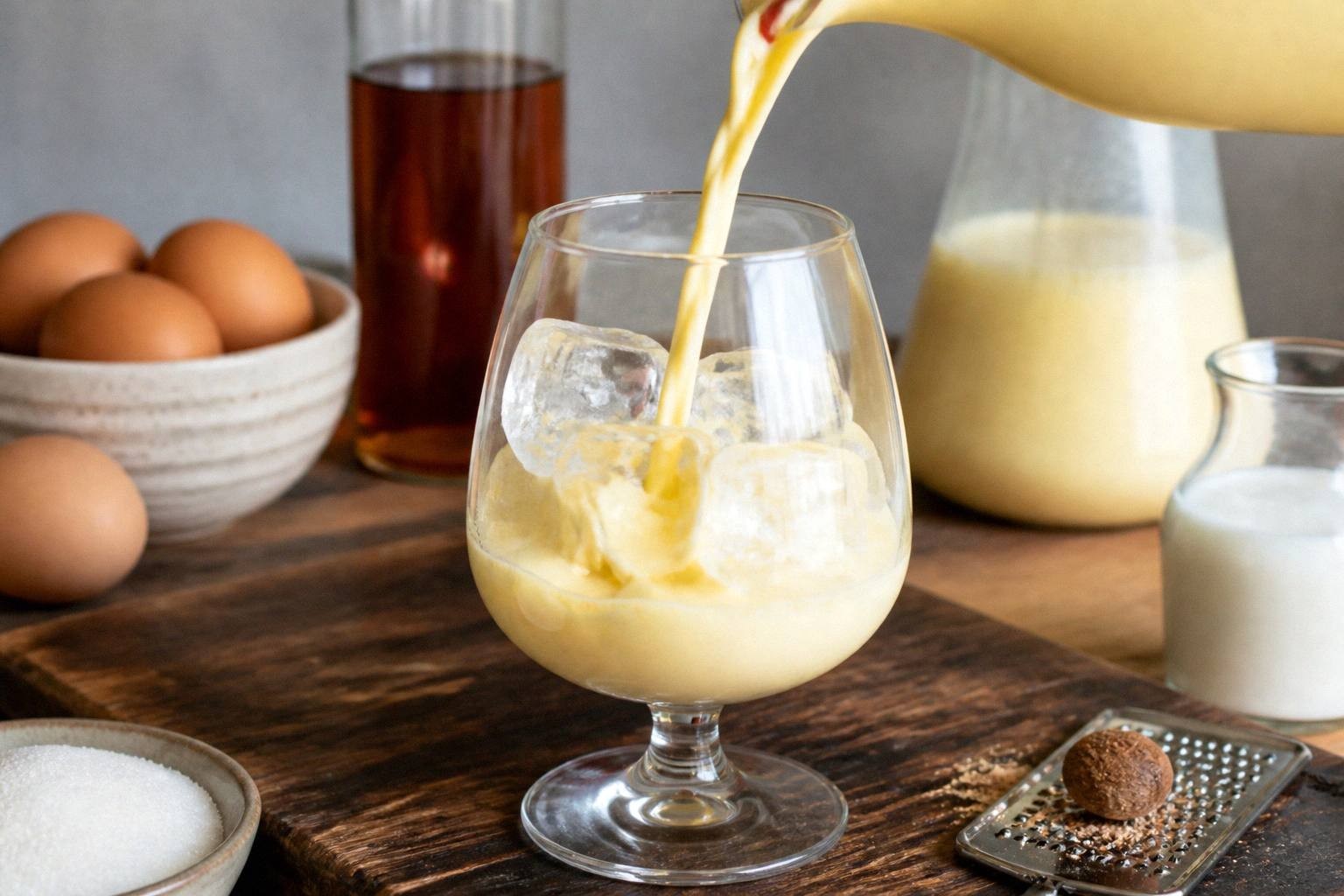
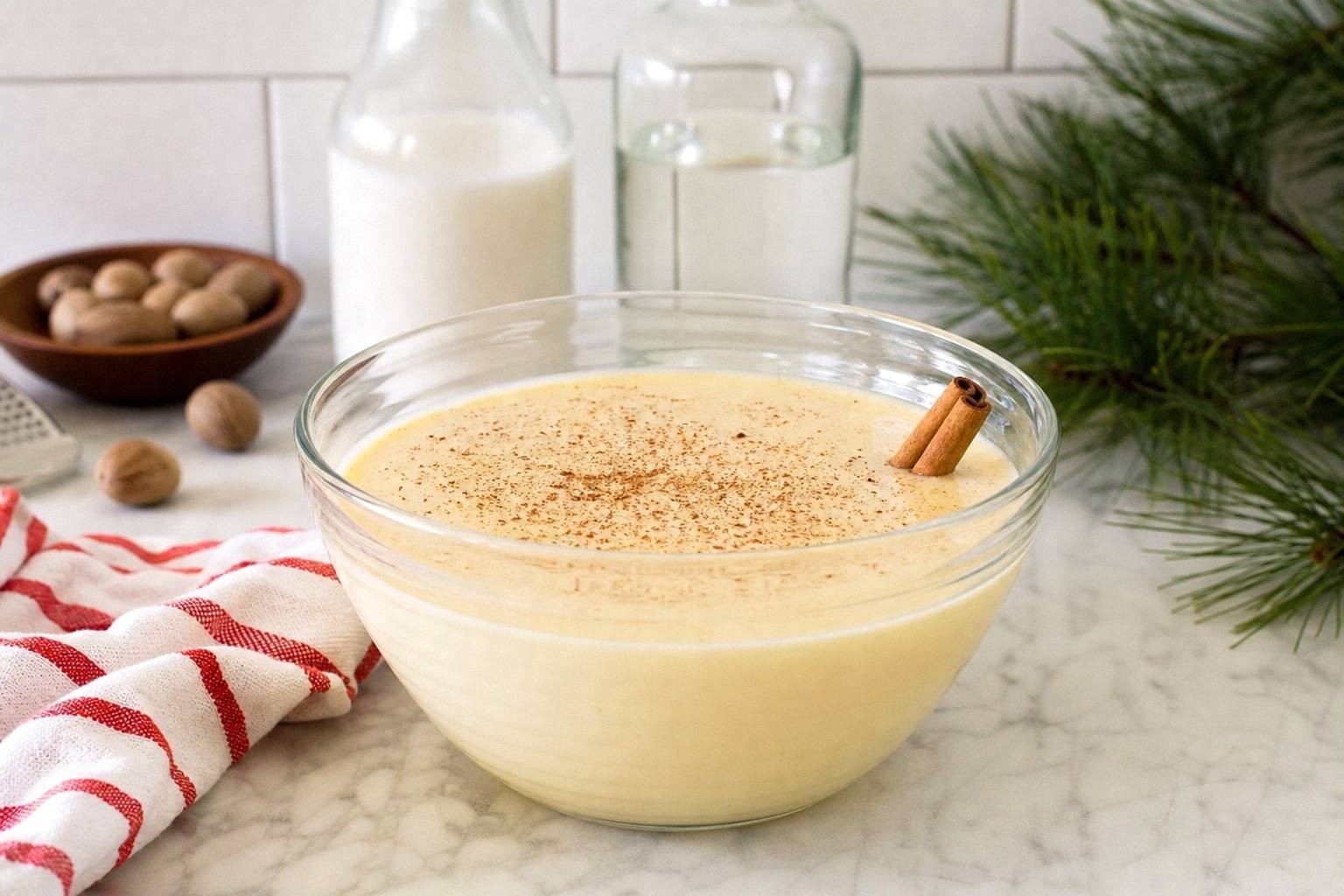
Use a complete recipe, such as Utah State’s Holiday Eggnog linked below, for its egg, milk and sugar quantities. Stir the specified egg-liquid mixture steadily over controlled heat and measure 160 F with a food thermometer. Check the mixture, not the pan bottom. The source’s 10-to-15-minute estimate does not replace temperature measurement. Spoon coating alone is not enough. Follow the rest of that recipe without adding untreated raw whites afterward.
Cool promptly in an ice-water bath or several shallow clean containers and refrigerate. Do not leave a deep pot on the counter waiting to become cold. Utah State’s recipe then chills 4 to 24 hours; allow that in the total preparation clock. Other recipes have their own quantities and clocks. This guide is not a second formula for arbitrary amounts of eggs and dairy.
Route 2: Pasteurized Eggs
Use shell eggs explicitly labeled pasteurized or a pasteurized refrigerated/frozen egg product labeled suitable for the intended uncooked use. An egg substitute may contain egg white and is not automatically egg-free. Measure equivalence from its label rather than replacing every egg with a guessed liquid amount. Thaw frozen products in the refrigerator.
Utah State advises an unopened pasteurized egg-product container for uncooked eggnog and using leftovers only in cooked dishes. Follow that restriction and the package storage instructions. FoodSafety.gov lists refrigerated unopened liquid egg substitute at one week and opened at three days; these are not universal ten-day guarantees for every pasteurized egg product.
Route 3: Commercial Eggnog
Choose a sealed commercial product, follow its refrigeration and use-by instructions, and keep it cold after opening. Commercial eggnog is a practical alternative, not evidence that every carton can be left on a cart. If adding toppings or spirits, label them and use the final mixture promptly. Product formulation and controlled processing matter; pasteurized eggs alone do not explain or guarantee every shelf life.
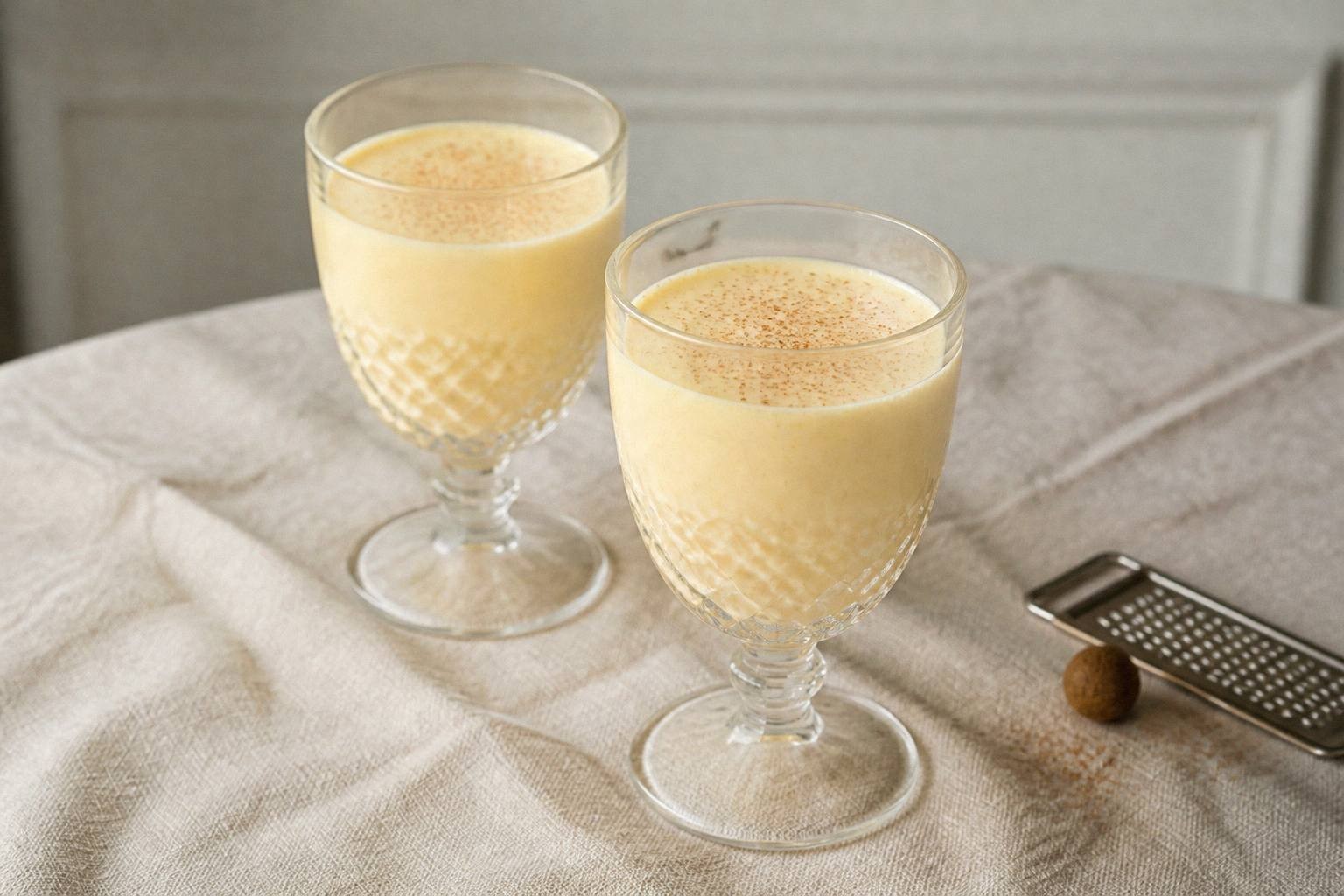
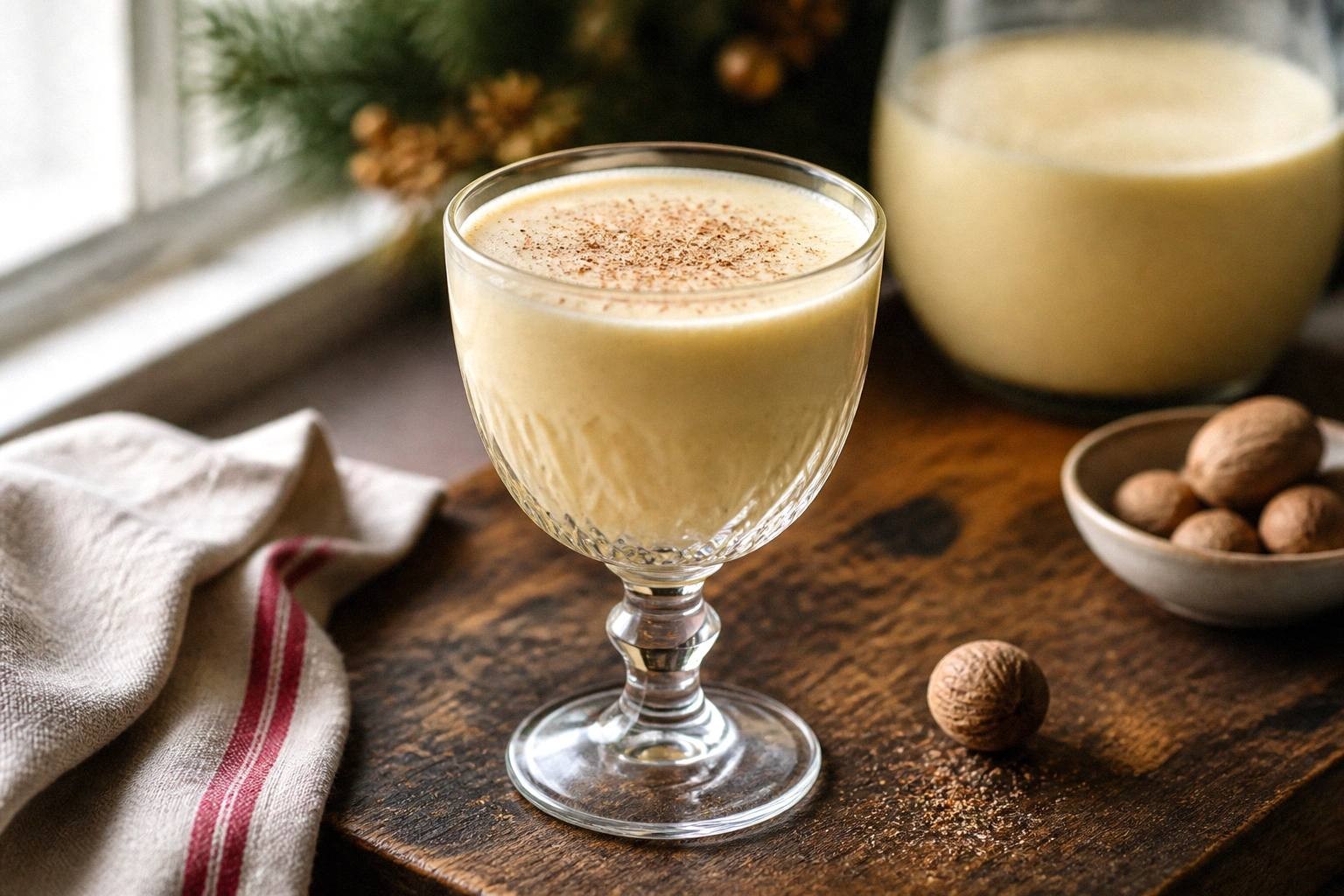
For a house dressed-up serving, pour 1/2 cup cold commercial eggnog, optionally add 1 tablespoon freshly whipped pasteurized cream and 1/32 teaspoon grated nutmeg, and serve immediately. That is roughly four fluid ounces plus an airy topping, ready in 5 minutes if cream is already whipped. For a separate adult version, add 1 fluid ounce rum or brandy to the eggnog, making five fluid ounces before topping. Alcohol does not extend the holding time. For four cream toppings, whip 1/4 cup cold heavy cream in a clean chilled bowl to soft peaks, about 2 to 4 minutes, then measure four tablespoon portions and reserve any extra cold.
Route 4: Egg-Free Choices
These are small house preparations compared with the original authors linked below. They have not been kitchen tested. Check ingredient and cross-contact labels for the actual allergy need; egg-free is not necessarily dairy-free or nut-free. Measure each finished batch and divide into four equal portions. Do not infer yield by adding dry ingredient volumes.
Cornstarch dairy drink
Whisk 1 tablespoon cornstarch into 1/4 cup cold whole milk taken from a total 3 cups milk. Put the slurry and remaining milk in a saucepan, heat while stirring to a gentle boil, reduce to a simmer and stir about 5 minutes until slightly thickened. Follow the starch package if it specifies a different cooking requirement. Stir in 1/4 cup maple syrup, 1 teaspoon vanilla and 1/4 teaspoon nutmeg. Cool promptly in shallow containers or over an ice bath, then refrigerate at least 4 hours until cold. Active time is about 15 minutes; allow about 4 1/2 hours total, longer if not cold. Recovery is roughly three cups plus dissolved sweetener, affected by evaporation; measure and divide by four.
Cashew or coconut drink
For the cashew house batch, cover 1/2 cup raw cashews with 2 cups freshly boiled potable water for 5 minutes, then drain and discard that water. This softens nuts and does not claim pasteurization. Blend with 2 cups chilled packaged plant milk, 2 tablespoons maple syrup, 1/2 teaspoon alcohol-free vanilla flavoring, 1/4 teaspoon nutmeg and 1/8 teaspoon cinnamon until smooth, about 1 to 2 minutes within the blender instructions. Refrigerate promptly at least 1 hour until cold. Allow about 15 minutes active and at least 75 minutes total. Measure blended recovery; divide by four. Contains tree nuts.
For a coconut version, omit nuts and soaking water. Blend 1 cup full-fat canned coconut milk with 1 cup chilled packaged plant milk and the same sweetener and flavorings. Chill as above, about 10 minutes active and at least 70 minutes total. It is a coconut-flavored drink with different body, not a cashew equivalence. Measure recovery and divide by four.
Condensed-milk drink
Whisk 2 cups cold pasteurized whole milk, 1/4 cup sweetened condensed milk, 1/2 teaspoon vanilla and 1/8 teaspoon nutmeg until smooth, about 5 minutes. Measure the roughly 2 1/4 cups finished mixture and divide by four. Serve cold immediately or refrigerate promptly. This thinner house version does not need instant pudding; it is different from the Dairy Alliance’s fuller pudding recipe.
Instant-pudding drink
Use a product verified egg-free. Blend 1 cup milk, 1/4 cup sugar, 1.7 ounces by weight instant vanilla pudding mix, 3/4 teaspoon rum flavoring and 1/8 teaspoon each nutmeg, allspice and ginger. Stir in 1 1/2 cups more milk, then refrigerate at least 1 hour. Measure recovery and divide by four. Allow 10 to 15 minutes active, at least 70 to 75 total. Instant mix only; cooked pudding mix needs its own package method. Use alcohol-free flavoring if avoiding alcohol completely.
For these egg-free house drinks, make and serve the same day under cold holding. This conservative house policy is not a measured shelf-life study, and the federal eggnog chart does not certify every plant-milk or starch formula.
Whipped Whites and Other Additions
Cooking the base does not treat raw egg whites folded in afterward. Use pasteurized whites labeled for the intended application and follow their whipping directions, or omit them. Their suitability for whipping differs by product; extra time is not a guarantee. Plain whipped pasteurized cream is the egg-free foam option described above. Avoid adding unmeasured spices or spirits as a preservation strategy.
Storage and Serving
FoodSafety.gov lists properly prepared homemade eggnog at 2 to 4 days refrigerated, and commercial eggnog at 3 to 5 days; follow any shorter package limit. This window does not make an untreated raw-egg batch safe. Cooking or pasteurized ingredients do not create permission for prolonged aging. The chart says do not freeze homemade eggnog and lists commercial at six months frozen, a quality/storage recommendation rather than proof of sterilization.
Keep eggnog at 40 F (4 C) or below, label its preparation date, and use small serving quantities. Discard after more than two cumulative hours without cold holding, or one hour above 90 F (32 C). Clean appearance, normal smell, and refrigeration afterward do not reverse poor handling.
Common Questions
Does alcohol make raw-egg eggnog safe?
No. Utah State says it cannot be relied upon to kill bacteria. Use the cooked, pasteurized or commercial route; serve alcoholic versions separately.
Which route is suitable for higher-risk guests?
FDA and extension guidance favor controlled cooking or pasteurized ingredients over untreated raw eggs. Use an alcohol-free preparation appropriate to the guest’s diet, including a commercial option when suitable. The former warning against every kind of eggnog for every higher-risk guest was too broad.
Does this guide certify the linked TFA recipes?
No. This article describes choices and handling; linked articles outside this ten-path batch are not certified here. For a complete source recipe, use the original author instructions linked below.
Sources and Review Limits
- Utah State University Extension: Five Tips for Safe Holiday Eggnog
- University of Minnesota Extension: Making homemade egg nog
- FDA: What You Need to Know About Egg Safety
- FoodSafety.gov: Cold Food Storage Chart
- Elke Living: Eggless Eggnog
- Nora Taylor: Vegan Eggnog
- The Dairy Alliance: Dairy Delicious Eggless Eggnog
- Robert Waters: Egg Not, Allrecipes