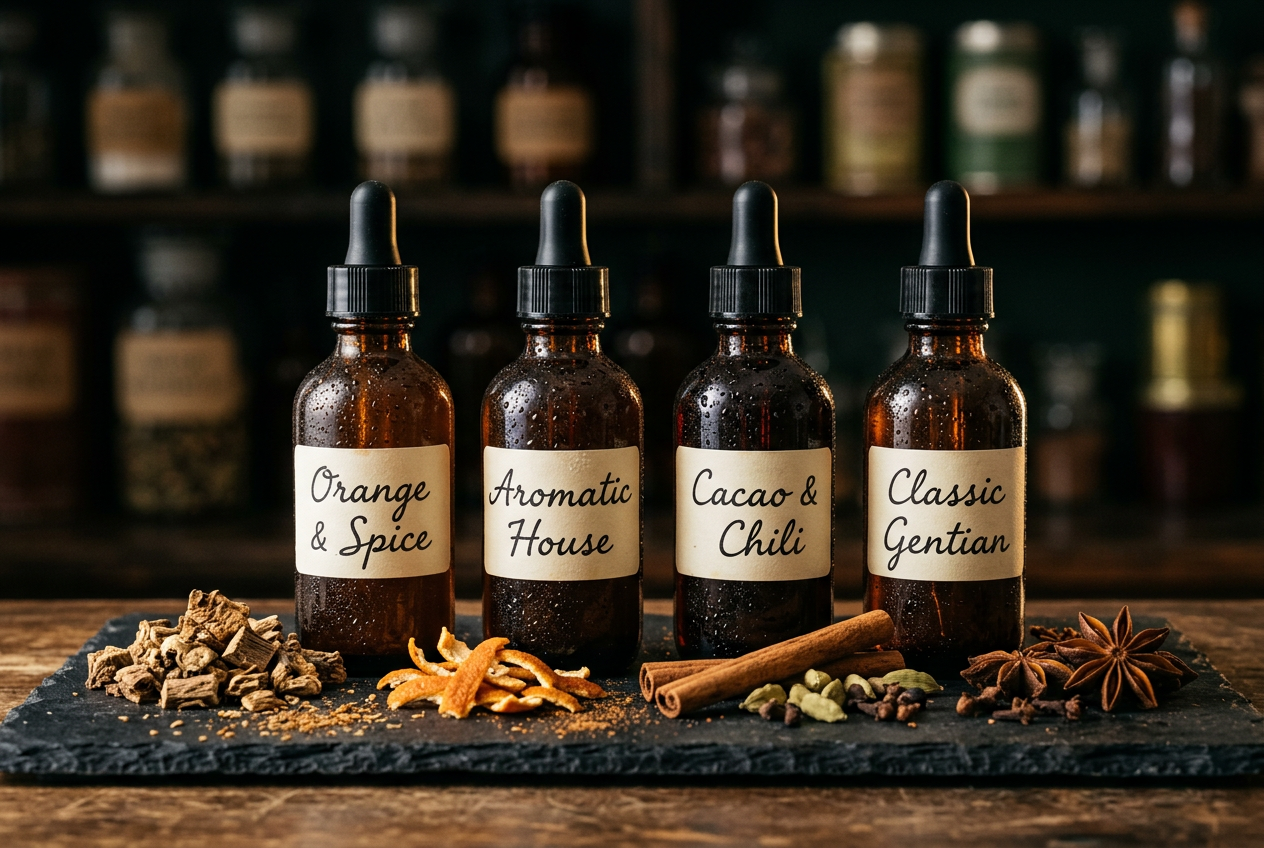
To make cocktail bitters, you steep a bittering ingredient like gentian root and a few flavor botanicals like citrus peel and spices in high-proof alcohol for about two to three weeks, shaking the jar now and then. Strain it twice, through a sieve and then a coffee filter or fine cloth, and bottle it in small dropper bottles. Kept somewhere cool and dark, the high-proof alcohol lets a batch last for years.
What Bitters Are
Bitters are concentrated alcohol extracts used by the dash. They’re too strong to drink on their own. Serious Eats writer Marcia Simmons calls orange bitters her cocktail Superman: a drop or two adds depth to a drink that tastes flat or too sweet, or ties together ingredients that aren’t quite getting along.
You can buy plenty. Angostura and Peychaud’s are the classics, and orange bitters from Regans’, Fee Brothers, The Bitter Truth and Angostura are easy to find. Making your own is about flavors you can’t buy, like a grapefruit-lavender blend or chocolate bitters for brown spirits.
All three recipes below contain alcohol, so a few dashes add a little alcohol to whatever you’re mixing. That matters if you’re making drinks for someone who avoids alcohol completely.
Bittering Agents vs Flavor Botanicals
As Simply Recipes describes it, most bitters recipes balance bittering agents against flavoring agents. The bittering agent makes it bitters, and the flavor botanicals make it yours.
| Role | Ingredient | Used in |
|---|---|---|
| Bittering | Gentian root (buy it cut, not powdered) | All three recipes below |
| Bittering | Quassia chips, which Serious Eats says add a woodsy, tea-like note | Orange bitters |
| Bittering | Wild cherry bark | Chocolate bitters |
| Bittering | Black walnut leaf, optional | Chocolate bitters |
| Bittering | Wormwood, optional, 1/4 teaspoon only | Chocolate bitters |
| Flavor | Dried orange zest | Orange bitters |
| Flavor | Grapefruit and lemon zest | Grapefruit bitters |
| Flavor | Caraway, cloves, star anise, anise seed | Orange bitters |
| Flavor | Lavender, coriander seed, juniper, fresh sage | Grapefruit bitters |
| Flavor | Cacao nibs, vanilla bean, cardamom, cinnamon | Chocolate bitters |
Sourcing. Specialty herb shops carry gentian root and quassia chips, and the Serious Eats recipes name Lhasa Karnak and Mountain Rose Herbs as online sources. Simply Recipes buys from Dandelion Botanicals, Tenzing Momo or Mountain Rose Herbs. Buy roots and barks sold for culinary use rather than digging up something you can’t identify.
About wormwood. It’s strong. The chocolate recipe marks it optional and uses only 1/4 teaspoon in 1 1/2 cups of bourbon. If you add it, source it carefully from an herb supplier and keep to that small amount.
Which Alcohol to Use
The proof matters more than the brand. Simply Recipes explains that higher-proof spirits pull out more flavor and do it faster.
- Neutral grain spirit or high-proof vodka lets the botanicals lead. The orange recipe uses 151-proof neutral grain spirit, and the grapefruit recipe uses 100-proof vodka.
- Bourbon or rye adds warmth that suits spiced and chocolate bitters. The orange recipe pairs the grain spirit with 101-proof bourbon, and the chocolate recipe uses high-proof bourbon. Simply Recipes suggests Knob Creek’s 120-proof single barrel, or the 100-proof ryes from Rittenhouse or Old Forester.
- Lower proof works in a pinch. If 100-proof vodka isn’t sold where you live, the grapefruit recipe’s author says standard 80-proof vodka is fine. For the orange recipe, she says to use another bourbon and the highest-proof vodka you can find.
Use drinking spirits only. Never denatured or rubbing alcohol.
Infuse Separately, Then Blend
Different botanicals give up their flavor at different speeds. Simply Recipes points this out, and it’s why good recipes don’t just throw everything in one jar on day one.
There are two ways around it:
- Separate jars. The Serious Eats orange bitters steep the orange zest, the spices and the bittering roots in three separate jars for 10 days. The spice and bittering jars are strained into the orange jar, which steeps for 11 more days. You control each part and can taste as you go.
- One jar, staggered. The chocolate bitters steep the cacao, vanilla and cardamom for a week, then the bittering agents and cinnamon go in for a second week. The grapefruit bitters steep the zest overnight before the rum, herbs and gentian join it.
Either way, shake the jar once a day and keep it in a cool, dark place.
How Long Bitters Take
| Recipe | Steeping | Then |
|---|---|---|
| Orange bitters | 10 days in three jars, then 11 days combined | Strain and bottle |
| Grapefruit bitters | Zest overnight, then 10 to 12 days with everything | Strain, add syrup, rest 1 day |
| Chocolate bitters | 1 week, then 1 more week after adding the bitter ingredients | Strain twice and bottle |
Straining and Bottling
- Strain twice. First through a fine-mesh sieve or cheesecloth to catch the solids, then through a coffee filter for clarity. Simply Recipes uses cheesecloth or a Superbag, a very fine mesh bag that’s easier to clean out, and strains a second time for a much clearer result.
- Sweeten if the recipe says so. The grapefruit bitters get 2 ounces of simple syrup after filtering, then rest for a day. Its syrup is 1 cup water and 1 cup sugar heated until the sugar dissolves, then cooled.
- Use small dark bottles. Bright light can change the flavor, so Simply Recipes prefers amber glass. Boston round bottles with droppers are cheap and easy to use, and 2- to 6-ounce sizes suit bitters you use a few drops at a time.
- Label them with the flavor and the date you bottled them.
Storage and Shelf Life
Store bitters in a cool, dark place. The Serious Eats grapefruit bitters, which include simple syrup, keep at room temperature for up to a year. Marcia Simmons says her unsweetened orange bitters last for years. Simply Recipes says its chocolate bitters will likely never go bad, thanks to the high-proof alcohol.
Three Recipes to Start With
Orange Bitters (Serious Eats)
Makes 1 1/2 cups.
- 4 oranges, zest only
- 1 cup 151-proof neutral grain spirit, divided
- 1/2 teaspoon caraway seeds
- 1/2 teaspoon cloves
- 1 star anise pod
- 1/2 teaspoon anise seed
- 1 teaspoon gentian root
- 1 teaspoon quassia chips
- 1 1/2 cups 101-proof bourbon
Peel the zest with a vegetable peeler and dry it on a baking sheet at 100F (40C) until dry but not burned, about 40 minutes. Store-bought dried orange peel works too. Put the cooled zest in a sealable jar with 1/2 cup of the grain spirit, choosing a jar big enough to take another cup of liquid later. Put the caraway, cloves, star anise and anise seed in a second jar with the other 1/2 cup of grain spirit. Put the gentian and quassia in a third jar with the bourbon. Shake all three.
After 10 days, strain the spice jar and the bittering jar through a fine-mesh sieve, then through a coffee filter into the orange jar, leaving the zest in. Shake and steep 11 more days. Strain out the zest, then filter through a coffee filter into your bottles.
Grapefruit Bitters (Serious Eats)
Makes 2 cups.
- 1 1/2 cups 100-proof vodka
- Peeled zest from 1 grapefruit
- Peeled zest from 1 lemon
- 1/4 cup light rum
- 1/2 teaspoon dried lavender blossoms
- 1/2 teaspoon whole coriander seeds
- 4 dried juniper berries
- 1 fresh sage leaf
- 1 1/2 teaspoons cut gentian root
- 2 ounces simple syrup
Seal the grapefruit and lemon zest in a jar with the vodka, shake and leave it overnight in a cool, dark place. Add the rum, lavender, coriander, juniper, sage and gentian, shake again and steep for 10 to 12 days. Strain through a cheesecloth-lined fine-mesh strainer, then filter through a coffee filter into the bottle. Add the simple syrup, shake and let it rest for a day.
Chocolate Bitters (Simply Recipes)
Makes 8 ounces.
- 1 1/4 cups cacao nibs
- 1 cinnamon stick
- 1 vanilla bean, split and scraped
- 5 cardamom pods
- 2 teaspoons gentian root
- 1 teaspoon wild cherry bark
- 1/4 teaspoon wormwood, optional
- 1 teaspoon black walnut leaf, optional
- 1 1/2 cups high-proof bourbon
Put the cacao nibs, vanilla bean, cardamom and bourbon in a large sealable jar, shake well and leave at room temperature for a week, shaking once a day. Add the gentian, wild cherry bark, wormwood, cinnamon stick and black walnut leaf, and give it one more week, still shaking daily. Strain through cheesecloth or a fine mesh bag into a clean jar, clean the filter and jar, and strain again. Funnel into small dark bottles.
Flavor Combinations to Try
Once you’ve made one batch, swapping the flavor side is the fun part. These ideas come straight from the recipe authors:
- Orange with cardamom and cinnamon. Marcia Simmons suggests bumping up the orange and adding both for bitters built for margaritas.
- Orange with more clove, or with coriander or ginger. Her orange recipe leans on anise, and she suggests playing up the cloves or adding coriander or ginger for a new profile.
- Grapefruit, lavender and juniper. The grapefruit recipe already pairs citrus with floral and gin-like notes.
- Chocolate with orange. Simply Recipes suggests pairing its chocolate bitters with a citrus bitters to brighten and deepen a spirit at the same time.
How to Use Homemade Bitters
- Orange bitters belong in a martini, a Vesper or a Martinez, according to Serious Eats. A few drops in a glass of seltzer is the easiest way to taste them on their own.
- Chocolate bitters suit brown spirits: aged rum, bourbon, a fall-spiced Old Fashioned.
- Aromatic and spiced bitters fit any Old Fashioned. Try them in our maple bourbon Old Fashioned with black walnut bitters or the apple cider Old Fashioned .
Common Questions
How are cocktail bitters made?
By steeping bitter roots or barks and flavor botanicals in high-proof alcohol for a couple of weeks or more, then straining and bottling the liquid. Some recipes steep each ingredient group in its own jar and blend them later. Others add ingredients to one jar in stages.
What are the ingredients in cocktail bitters?
A bittering agent, usually gentian root, plus flavorings such as citrus peel, spices, herbs, cacao or vanilla, and a high-proof spirit. Some recipes, like the Serious Eats grapefruit bitters, finish with a little simple syrup.
What type of alcohol is best for making bitters?
A high-proof spirit, because it pulls flavor out faster and more completely. Neutral grain spirit or 100-proof vodka keeps the botanicals in front. High-proof bourbon or rye adds its own warmth, which suits spiced and chocolate bitters.
What bitters do bartenders use?
Angostura and Peychaud’s are the classics. For orange bitters, Serious Eats lists Regans’, Fee Brothers, The Bitter Truth and Angostura as easy-to-find orange bitters, and notes that many bars mix more than one brand into a house blend.
Are cocktail bitters alcoholic?
Yes. Traditional bitters are made in high-proof spirit, so even a few dashes add a small amount of alcohol to a drink. Alcohol-free bitters are sold separately if you need a zero-proof option.
How long do homemade bitters last?
Years, if they’re made in high-proof spirit and stored cool and dark. The Serious Eats grapefruit bitters, which contain simple syrup, are rated for up to a year at room temperature.
Related Reading
- How to make herbal tinctures uses the same steep-and-strain method
- Botanical simple syrups for the sweet side of your bar