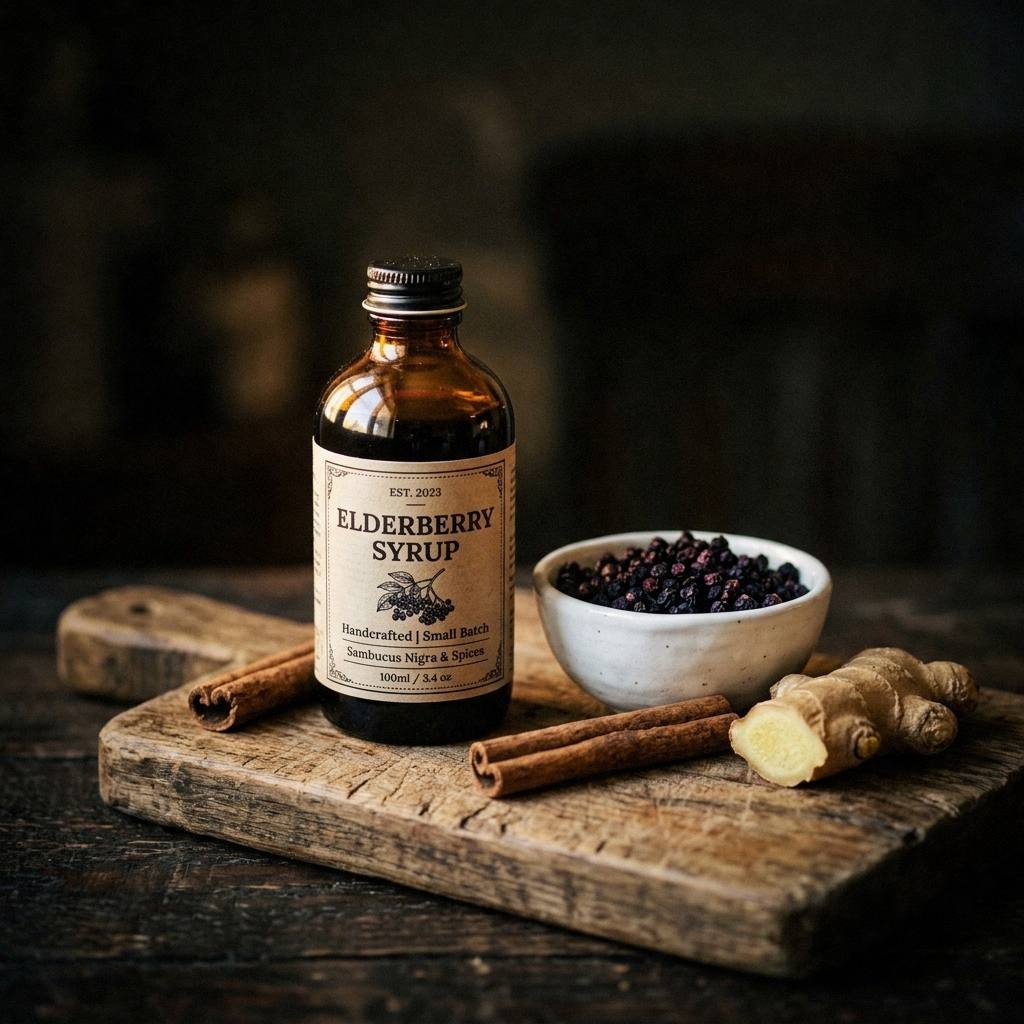
The Short Answer
The linked original honey-spice elderberry formula is withdrawn as a preparation guide while its process and storage remain unresolved. This page cannot assign it a refrigerated shelf life.
Oregon State Extension provides species-specific preservation guidance and distinct formulas. Those directions do not validate the linked blend. Use a documented preparation and its matching storage directions; do not can or pantry-store an unvalidated formula.
Why Elderberry Syrup Has a Shelf Life at All
Storage safety depends on the actual formula and processing, including acidity, available moisture, handling and temperature. Adding honey does not establish a preserved or sterile product. A sealed lid and a clean-looking jar are not evidence of safety.
Elderberry Syrup Shelf Life at a Glance
| Question | What this page establishes |
|---|---|
| Pantry storage | Not appropriate for an unvalidated formula |
| Refrigerated lifetime | No exact life established for the linked blend |
| Freezing | Cannot repair spoiled syrup or validate a preparation |
| Appearance and taste | Cannot establish safety |
What Actually Cuts a Batch’s Life Short
Follow the documented recipe’s handling and storage instructions. Use clean equipment and avoid contaminating a product with a used spoon. This page establishes no ranking of spoilage causes or preservation effect from changing honey quantities.
Signs Elderberry Syrup Has Turned
Elderberry syrup is opaque and nearly black, which makes it harder to read than a pale syrup. Use your nose and the surface.
Start a new jar if you see or smell any of these:
- Fuzzy growth on the surface, any color
- Green, blue, gray, white or pink patches
- A cidery, beery or wine-like smell
- Bubbles rising in a jar that was still when you put it away
- A lid that domes upward or hisses on opening
- A sharp solvent smell instead of dark fruit and warm spice
- Anything slimy or stringy on the spoon
Do not scoop growth off the top and use what is underneath. Syrup is a soft, high-moisture food, so what you can see on the surface is not the whole of what is in the jar.
Fizzing Is a Message, Not a Feature
A syrup that starts bubbling on its own has picked up wild yeast, and the yeast is eating the sugar. Some people will tell you this is fine and you have accidentally made a soda. You have not. The flavor turns thin and cidery, the sweetener that was doing the preserving is being consumed, and you have no idea what moved in alongside the yeast.
Pour it out, wash the jar properly, and start again. Do not treat a new batch of the unresolved formula as a validated replacement.
The Clean Spoon Rule
Every visit to the jar gets a dry, unused spoon. Never the spoon that has been in your mouth, never the one that has been in something else, never a finger.
If that sounds like a lot of spoons, decant instead. Keep the main batch in a jar you rarely open and pour a few days’ worth into a small bottle. The bottle absorbs all the handling and the mother jar stays untouched.
Honey, Babies, and One Hard Line
If your syrup is made with honey, it is off the table for infants. Botulism spores turn up in honey, and MedlinePlus states that these foods should not be fed to infants less than 1 year old . That is not a caution about elderberry. It is a caution about honey, and it applies to every honey-sweetened thing in your kitchen.
Cooking the syrup does not settle the question. Do not work around it.
If You Want It to Keep Longer
Use a documented preparation with matching storage instructions. Do not improvise a preservative, substitute an alcohol extraction, or top up an old jar with a fresh batch. Freezing is not a remedy for spoilage or an unvalidated formula.
Thin Is Not the Same as Spoiled
Consistency depends on the formula and reduction. Thinness alone does not determine safety. Read why elderberry syrup will not thicken before you assume a runny jar has gone off.
Common Questions
Does elderberry syrup need to be refrigerated?
Use the documented preparation’s storage directions. OSU publishes specific refrigerated/frozen syrup guidance; it does not validate the linked honey-spice formula.
Can I store elderberry syrup in the pantry?
No. An unopened commercial bottle is a different product with different processing behind it. The linked original formula remains withdrawn; refrigeration alone does not validate it.
Why did my elderberry syrup start bubbling?
Unexpected bubbles can indicate fermentation. Do not taste the jar; discard it and clean the equipment. Use a documented preparation for any future batch.
Can I just skim the mold off the top?
No. Syrup is soft and high in moisture, so surface growth is not contained to the surface. The jar goes out.
Does using maple syrup instead of honey change how long it keeps?
Changing sweetener changes the formula. No comparative shelf life has been established here for maple syrup versus honey. A honey-free recipe still is not a recommendation to feed herbal syrup to an infant.
Do fresh or dried berries make a batch keep better?
Species, formula, process, storage and handling all matter. The differences between the two are in dried vs fresh elderberries .
Is it still safe if it tastes more sour than it did?
Do not taste a questionable jar to judge safety. Discard syrup with an unexpected sourness, fermentation, mold or another change. Absence of visible spoilage does not establish a safe storage lifetime.
Oregon State Extension distinguishes elderberry varieties and preservation formulas. Its published syrup and canning instructions do not validate the honey-spice formula linked here. Freezing cannot repair syrup that has already spoiled.