The Short Answer
Curdled eggnog is egg protein that clumped instead of staying suspended in the dairy. Once those proteins knot together, they squeeze out liquid, and you get grainy specks in thin milk instead of one silky drink.
Four things cause it: heat that climbed too fast, cold yolks hit with hot dairy, spirits poured in all at once, or a batch that simply sat too long. The first three are mixing problems and are often fixable. The last one is not.
The base method is in the classic eggnog recipe if you want to compare against what you did.
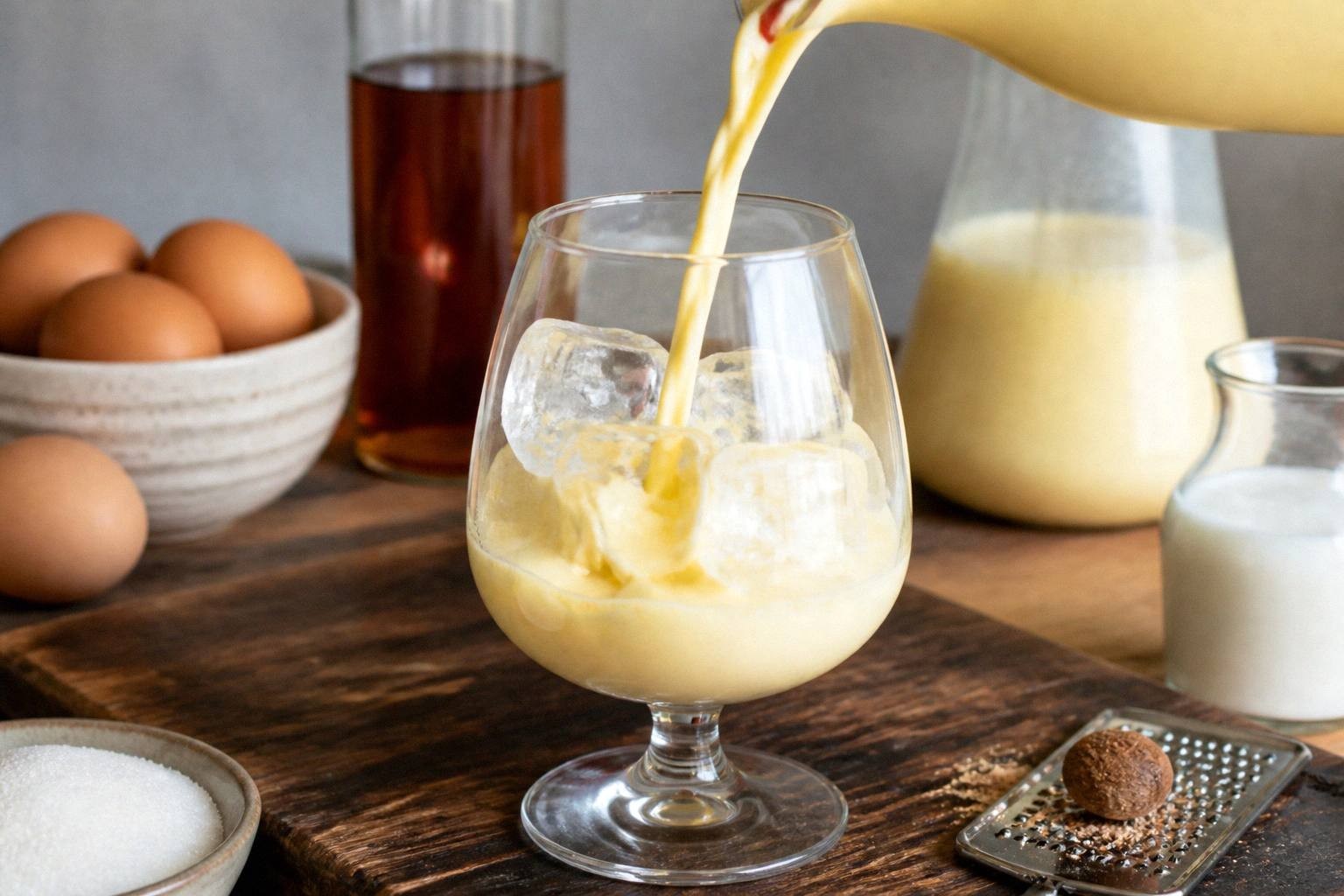
What Curdling Actually Is
Egg yolks are mostly water, fat, and protein. In a good batch those proteins stay loose and spread through the liquid, thickening it evenly. That is what makes eggnog feel like a drink rather than a glass of milk.
Push them too hard and they bond to each other instead. The protein pulls into tight knots, the water it was holding gets pushed out, and the drink separates into solids and thin liquid. Cooks call that breaking or curdling. It is the same reaction as scrambled eggs, just happening in a pitcher instead of a pan.
Nothing you do afterward reverses that bond. Rescuing a curdled batch means breaking the knots up small enough that you stop noticing them, not putting the protein back the way it was.
Cause 1: The Base Got Too Hot
This is the most common one, and only applies if you cooked your base rather than mixing it raw.
Both Utah State University Extension and the University of Minnesota Extension give the same target for a cooked eggnog base: heat the egg mixture until it reaches 160 F , stirring the whole time. Utah State describes it as roughly 10 to 15 minutes over medium heat in a double boiler, until the mixture coats a metal spoon.
The trouble comes from rushing it. Direct high heat on a thin-bottomed pan cooks the yolks against the metal before the rest of the pot catches up, and those are the specks you find later. A double boiler, medium heat, and constant stirring exist to stop exactly that.
Use a thermometer rather than guessing. Pulling the pot at the right moment is the whole technique, and eyeballing it is how most home batches overshoot.
Cause 2: You Skipped Tempering
Tempering means introducing the hot liquid to the yolks slowly instead of all at once.
If you pour hot milk straight into a bowl of cold yolks, the yolks at the point of contact cook instantly while the rest are still cold. You get scrambled threads through an otherwise fine batch.
The fix is to ladle a small amount of the hot dairy into the yolks while whisking, then another, then another, until the yolk mixture is warm to the touch. Only then does it go back into the pot. It takes an extra minute and it prevents the single most avoidable version of this problem.
Cause 3: The Spirits Went In Too Fast
Alcohol denatures egg protein much the way heat does. Dumping two cups of rum into a finished dairy base in one pour can shock the proteins at the point of contact and leave you with fine grain through the batch.
Add the spirits in a thin stream with the mixer or whisk running, and add them to a base that is already cool. A warm base plus a fast pour is the combination that breaks.
If you are making a batch ahead and adding spirits later, the same rule applies at that later step. Making eggnog ahead of time covers where the alcohol belongs in the schedule.
Cause 4: It Sat Too Long
This is the one to take seriously, because it is not a technique problem at all.
The FoodSafety.gov cold food storage chart gives homemade eggnog 2 to 4 days in the refrigerator. A batch that was smooth when you made it and lumpy on day six did not develop a mixing flaw in the fridge. Something changed in it.
Do not blend that one smooth and serve it. Curdling that appears on its own, days after mixing, especially alongside a sour smell, is a sign to throw the batch out. How long homemade eggnog lasts covers the full list of spoilage signs.
Separation Is Not Curdling
Worth separating these two, because they look similar in a container and mean very different things.
Separation is a cream layer floating to the top over a thinner liquid below, with no lumps in either. It happens to nearly every homemade batch overnight, and a stir or a shake fixes it completely.
Curdling is visible grain or lumps that stay lumpy no matter how much you stir. If you can whisk it smooth in ten seconds, you had separation and there was never anything wrong.
How to Rescue a Broken Batch
Try texture repair only if the base reached 160 F (71 C) throughout, or a complete uncooked method used labeled pasteurized eggs, and subsequent handling stayed within its refrigerated/time limits. If cooking, egg treatment or handling is unknown, do not taste, blend or serve it as a rescue. For a batch meeting those conditions, try these in order:
- Immersion blender. Run it through the batch until the grain disappears. This shears the protein knots down small enough that the texture reads smooth again, and it works more often than people expect.
- Countertop blender. Cool the liquid first, follow the blender’s permitted temperature and liquid fill limit, and secure its lid. Never blend hot eggnog in a sealed blender; eggnog also foams.
- Fine mesh strainer. Pour the batch through and discard what the mesh catches. You lose a little volume and gain a clean texture.
- Strain then blend. For a badly broken batch, do both.
- Chill and re-whisk. Sometimes a cold batch whisks smoother than a warm one.
None of these work on a batch that curdled from age. That one goes down the drain regardless of how good the blender is.
Preventing It Next Time
- Cook the base in a double boiler or over low heat, never high.
- Stir constantly while it heats, especially around the edges of the pot.
- Use a thermometer and pull at 160 F rather than guessing by eye.
- Temper the yolks with hot dairy gradually.
- Cool the base before the spirits go in.
- Add alcohol in a thin stream with the whisk running.
- Cool promptly in shallow clean containers or an ice-water bath and refrigerate at 40 F (4 C) or below within 2 hours, or 1 hour above 90 F (32 C). Keep inside the 2-to-4-day window from preparation; texture repair does not reset it.
- Discard after a cumulative 2 hours without refrigeration, or 1 hour above 90 F. Do not taste to decide whether unknown handling was safe.
If you would rather skip the custard step entirely, a batch built on pasteurized eggs never needs heating at all, which removes two of the four causes above. Eggnog without raw eggs walks through both routes.
Common Questions
Can you drink curdled eggnog?
Only if its cooked/pasteurized-egg method and subsequent handling met the safety conditions above. Blending changes texture, not safety; a fresh untreated-raw or undercooked batch is not approved by being fresh. If it curdled on its own in the fridge, or smells sour, throw it out.
Why did my eggnog curdle when I added the rum?
The alcohol most likely went in too fast, into a base that was still warm. Add spirits in a thin stream to a cooled base with the whisk running.
Can I fix curdled eggnog with a blender?
Often, yes. An immersion blender breaks the clumped protein down finely enough that the texture reads smooth. It fixes texture only. It does not make an old batch safe.
Does store-bought eggnog curdle?
Rarely on its own, because it is stabilized and made with pasteurized eggs. It can still break if you heat it hard or stir it into something acidic, like coffee that has gone cold and sharp.
Why is my eggnog grainy but not lumpy?
Fine grain usually means the base got slightly too hot rather than badly overcooked, or the yolks and sugar were not beaten smooth before the dairy went in. A blend usually clears it up.