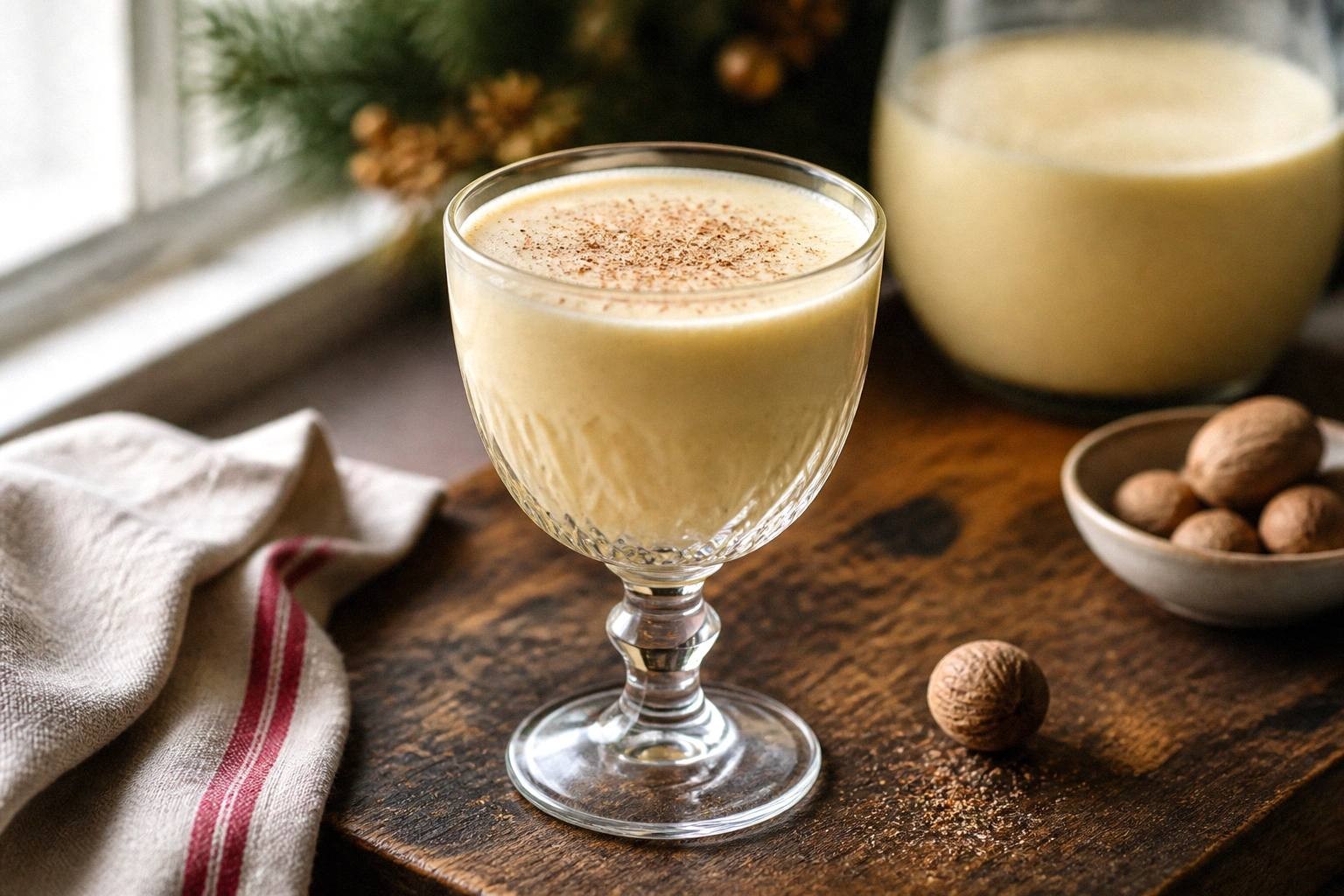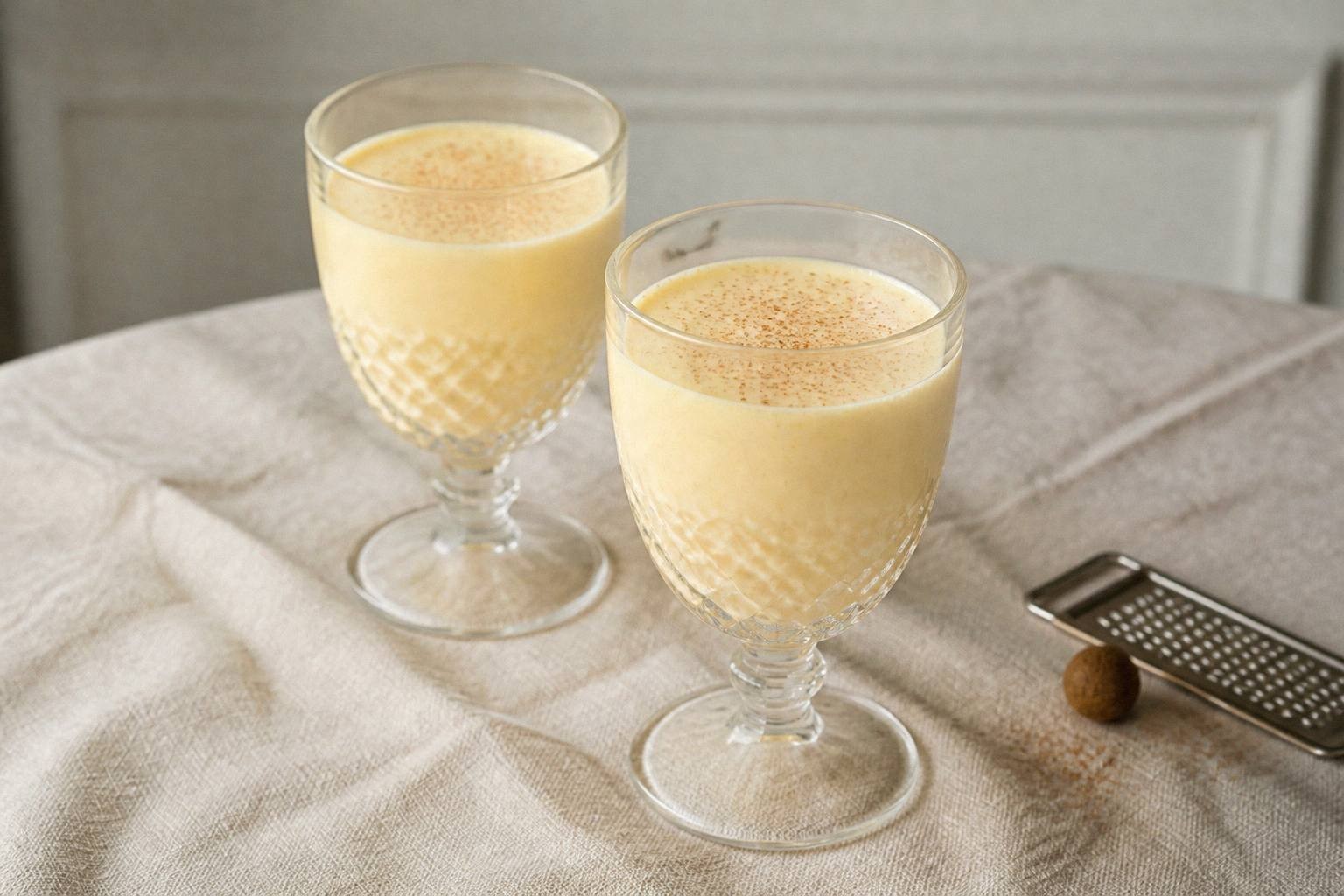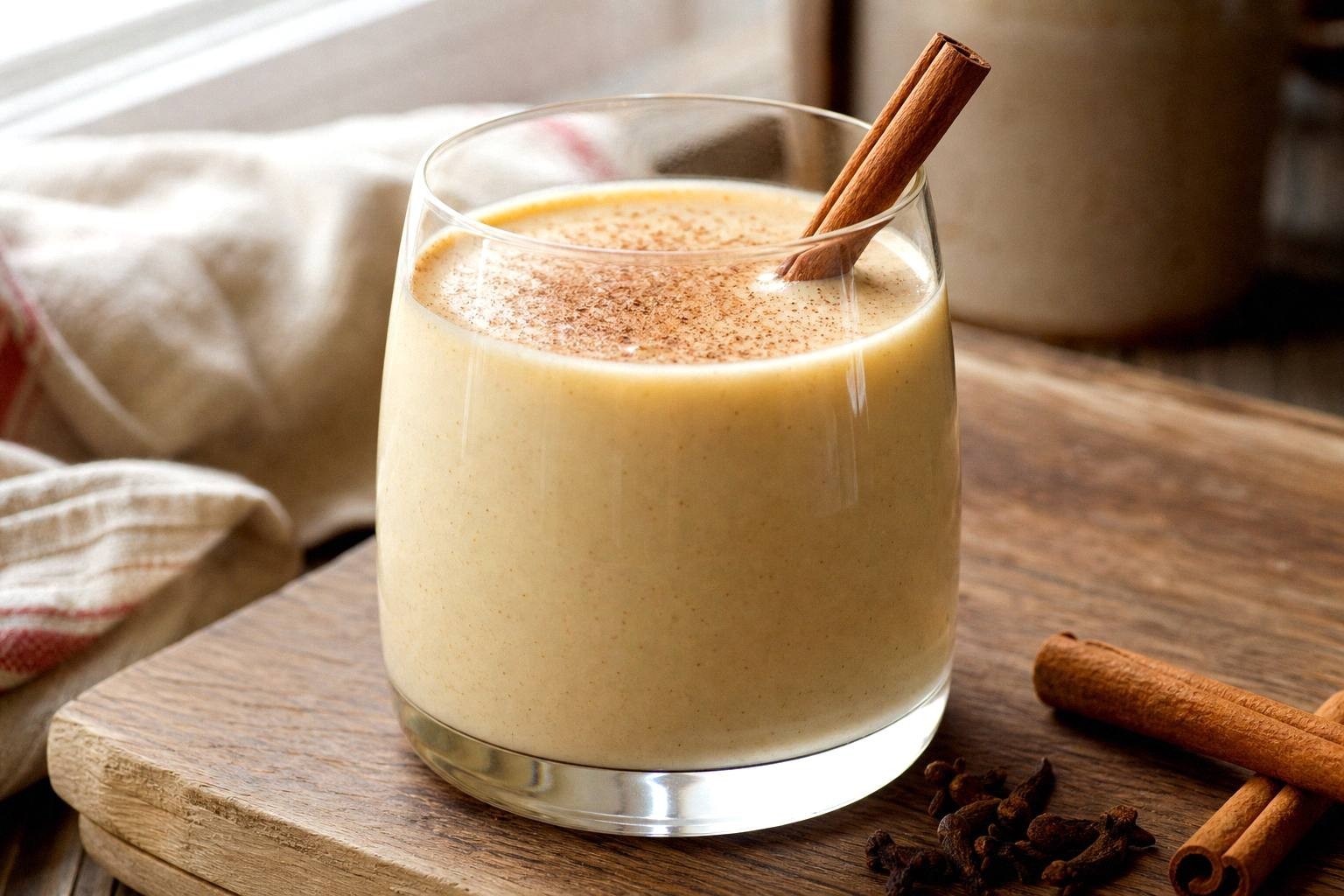
Whole eggs cook into this classic eggnog base before it is chilled. Rum or brandy is added to individual adult servings; it is not used to make raw eggs safe. The card includes the full cooling and storage method.
Cooked Classic Eggnog
12 small servings; divide measured recovery equally. about 4 hours 30 minutes including at least 4 hours chilling; longer if not thoroughly cold.
Ingredients
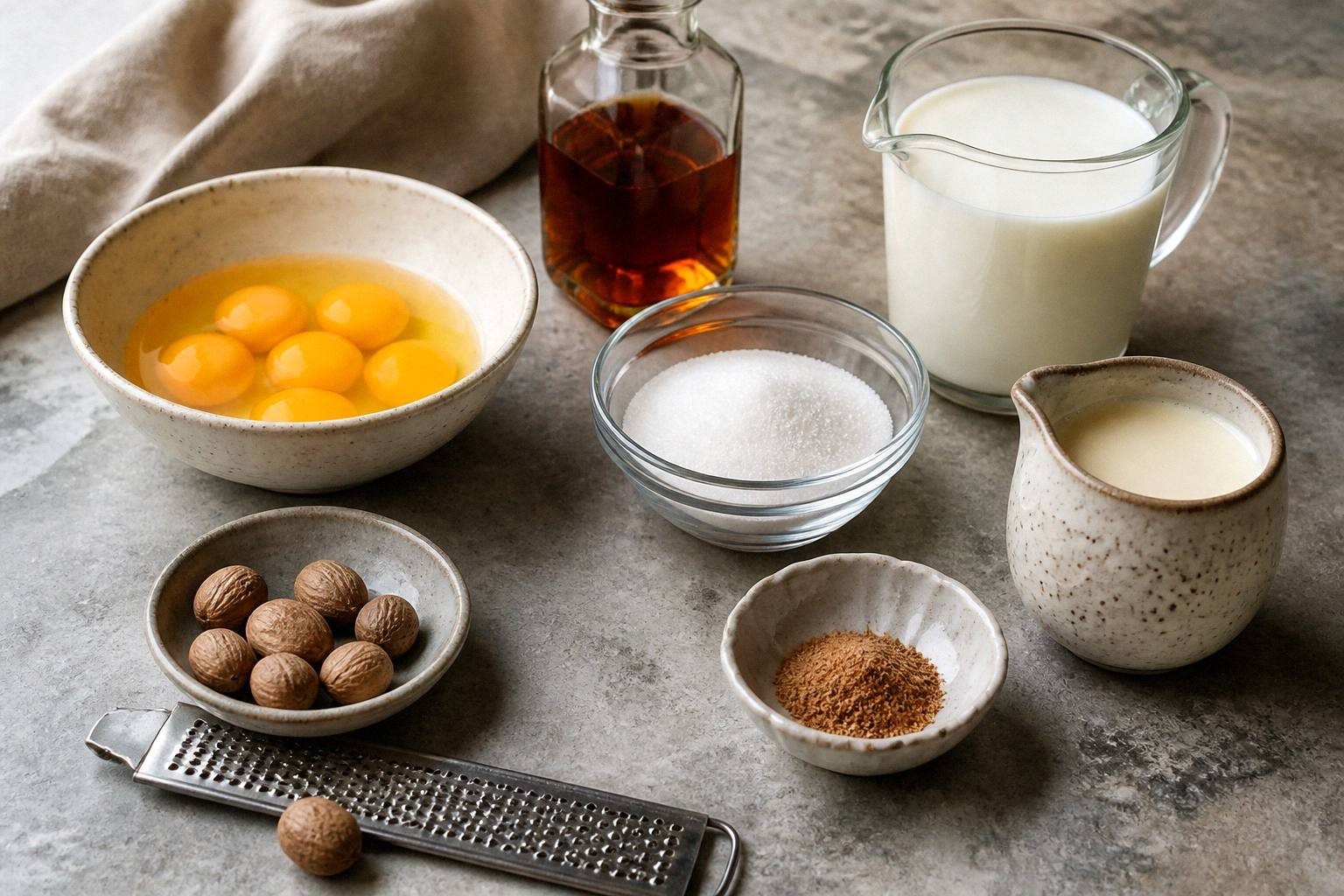
- 8 large eggs
- 2/3 US cup granulated sugar (about 133 g), all for the cooked base
- 3 cups pasteurized whole milk, divided
- 2 cups pasteurized heavy cream
- 1 teaspoon vanilla extract
- 1/4 teaspoon ground nutmeg, divided among servings
- Optional adult servings: up to 1 1/2 fluid ounces rum, brandy or bourbon per glass
Method
- Wash hands and equipment. In a heavy saucepan whisk whole eggs, sugar and 1 1/2 cups milk until smooth. Keep raw eggs separate from serving tools.
- Cook over low to medium-low heat, stirring constantly, until a food thermometer reads 160 F (71 C) throughout the mixture. Allow about 15 minutes, longer if needed; spoon coating alone is not the safety endpoint. Do not boil.
- Remove from heat; stir in remaining 1 1/2 cups cold milk, cream and vanilla. Transfer promptly to shallow clean containers or cool in an ice bath, stirring with a clean utensil; refrigerate within 2 hours, or 1 hour above 90 F.
- Refrigerate covered at 40 F (4 C) or below until thoroughly cold, allowing at least 4 hours, longer if needed. Measure final recovery and divide it equally into 12 servings, approximately 4.5 fluid ounces each before spirits.
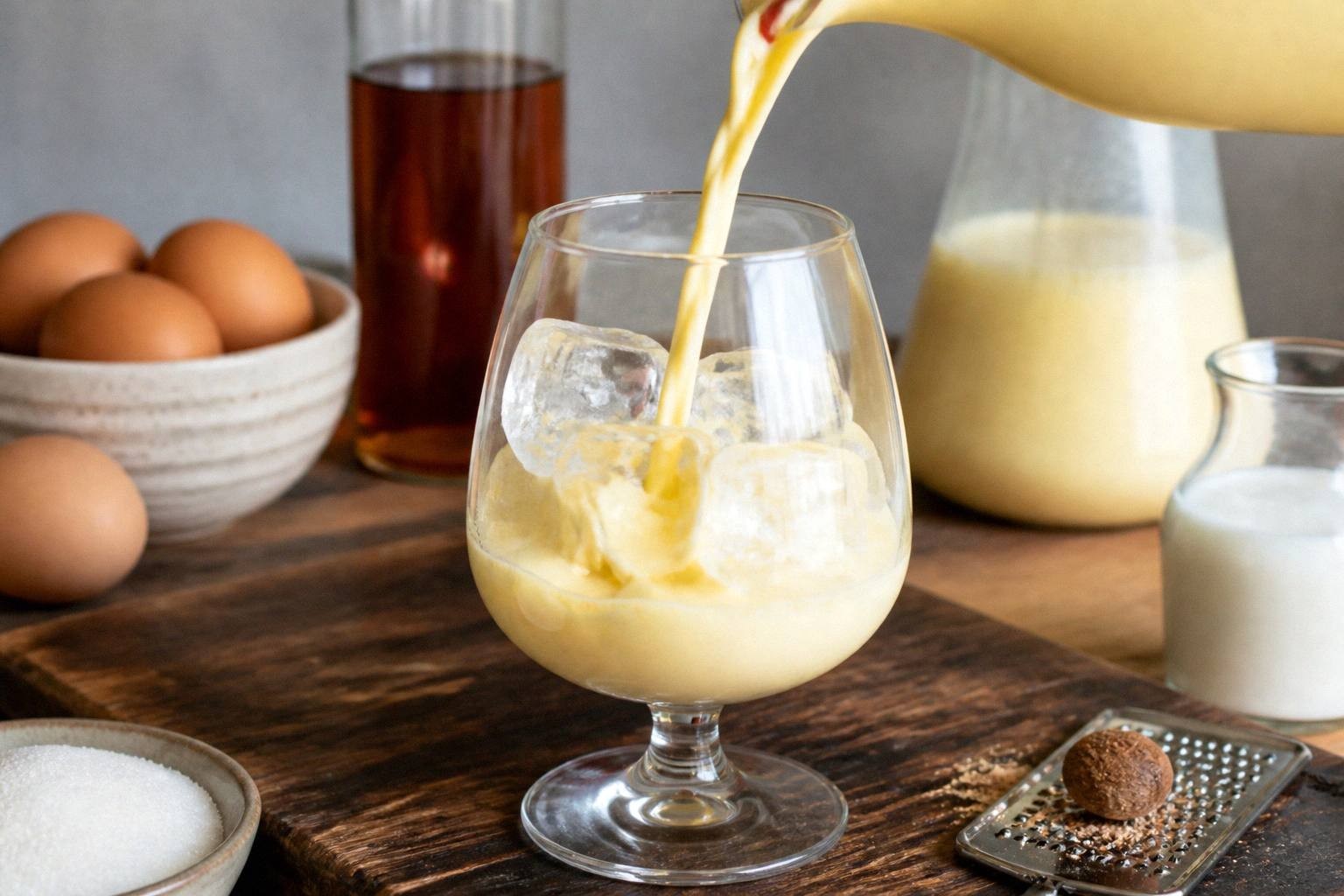
- Divide nutmeg across 12 glasses. For an adult alcoholic serving add up to 1 1/2 fluid ounces spirit to an individual pour and use a glass of at least 10 fluid ounces. Alcohol supplies flavor, not safety.
- Refrigerate leftovers promptly at 40 F or below. Use within 2-4 days from preparation, choosing 2 days as the house target and following any shorter ingredient label. Do not age for weeks or freeze homemade eggnog.
The cooking endpoint follows USU Extension: Safe Holiday Eggnog . House whole-egg/dairy formula retains the original 8 eggs and 3 cup milk/2 cup cream quantities; sugar weight corrected from 5 oz to about 133 g. Final volume depends on eggs and evaporation; do not promise an exact 12 cup yield.
Foam without raw whites
For a cream topping, beat 1/2 cup cold pasteurized heavy cream with 1 tablespoon sugar until soft peaks, about 2-3 minutes. Divide into 12 equal toppings immediately before serving, refrigerating any extra promptly. This uses extra cream and sugar beyond the main card. The former raw separated whites and basic raw-egg shaker methods are replaced by the cooked route. If an uncooked egg-white recipe is selected elsewhere, it requires a pasteurized product suitable for that use; this page provides no raw-white folding recipe.
Single serving and lighter variants
For one plain serving, pour 1/12 of the measured chilled cooked base; add up to 1 1/2 fluid ounces spirit only for an adult. The former 1 raw egg shaker recipe is removed. To lighten a served portion, stir in 1 tablespoon cold pasteurized milk; it adds 1/2 fluid ounce. For a richer or lighter next batch, change the 3 cup milk/2 cup cream split to 2 cup milk/3 cup cream or 4 cup milk/1 cup cream, keeping five cups dairy total and the same cooking/cooling endpoints. Whole eggs remain cooked. No alcohol-free shelf-life penalty is inferred. Strict alcohol-free branch uses 1 teaspoon alcohol-free vanilla flavoring in the batch and omits spirits; do not add alcohol-containing rum extract.
Make-ahead and troubleshooting
Prepare the cooked base a day before service within the normal 2-4 day refrigerator window; keep 40 F or below throughout. Spirits may be omitted or chosen per glass and do not extend storage. Do not age the base or add unpasteurized whites after cooking. Separation in an otherwise correctly handled batch may be stirred; uncertain handling or spoilage means discard without tasting. Do not prescribe sugar or alcohol to mask an eggy/off flavor. Curdling indicates excessive heat, so use low heat and constant stirring for the next batch. A thin cooked base is chilled to develop its texture; more beating alone cannot establish safety.
Measuring and Keeping Drinks Cold
Liquid ounces mean US fluid ounces, not weight. A US cup is 8 fluid ounces, a tablespoon is 1/2 fluid ounce and a teaspoon is 1/6 fluid ounce. Metric amounts are exact where used; a litre is about 4.23 US cups. Drink volumes exclude ice and fruit. Choose a glass with room for the stated liquid, ice and fizz.
Use clean equipment and wash produce under running water before cutting. Choose pasteurized or otherwise safety-treated packaged juices, food-grown culinary herbs and potable water. Follow opened-package instructions. A concentrate must be diluted according to its label unless explicitly measured as concentrate. For alcohol-free drinks, choose mixers labeled 0.0% alcohol; the name ginger beer or kombucha alone is no guarantee. Avoid alcoholic bitters and alcohol-containing extracts in strict alcohol-free versions.
Keep prepared bases, cut fruit and homemade syrups at 40 F (4 C) or below. Check serving liquid with a thermometer; frozen fruit alone cannot establish cold holding. Discard perishables after more than two cumulative hours without cold holding, or one hour above 90 F (32 C). Replace warm remnants with clean chilled pitchers. Normal smell or appearance does not prove safety.
Use homemade fruit/herb syrups and juice bases the day made, or freeze promptly in small portions after cooling; thaw in the refrigerator and use that day. This is a conservative house handling policy, not a tested shelf-life claim. Add carbonation at serving, outside a sealed shaker. For hot drinks, hold at 140 F (60 C) or above, cool leftovers promptly in shallow containers or an ice bath and refrigerate within the limits above. A slow cooker’s low or warm setting is not a temperature reading.
Keep rosemary , thyme, cinnamon sticks, vanilla pods and whole spices on the table after straining, rather than in serving glasses. Fresh food-grown mint or basil leaves and washed fruit slices can be edible garnishes. Use glass or an intact food-safe lined mug for acidic drinks; bare copper is unsuitable.
These formulas are culinary house adaptations compared with the cited methods. No kitchen, sensory, pathogen, clinical, pressure, alcohol or shelf-life testing is claimed. Images are retained illustrations and may depict the earlier recipe; ingredient lists and methods govern preparation.