Two Ingredients
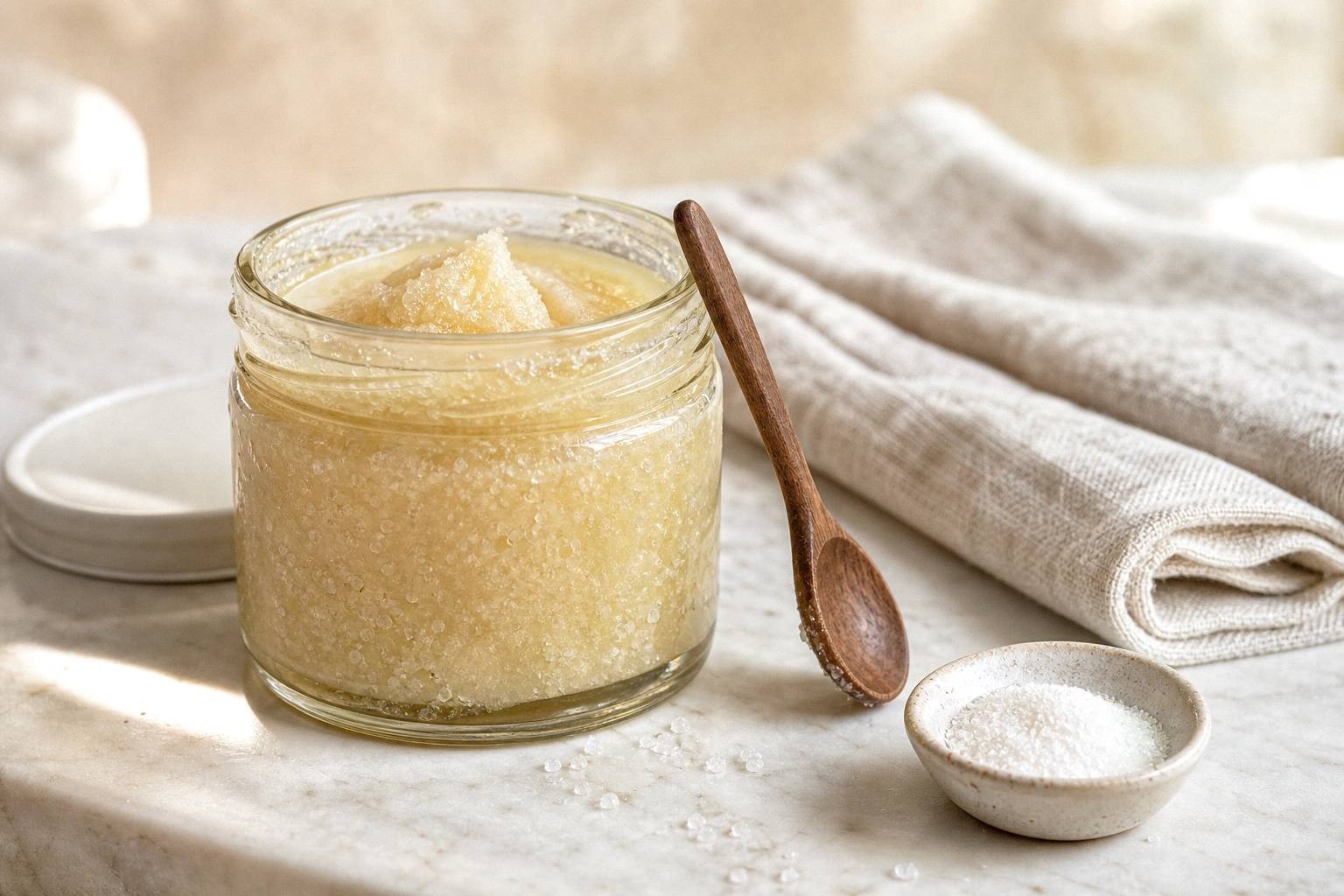
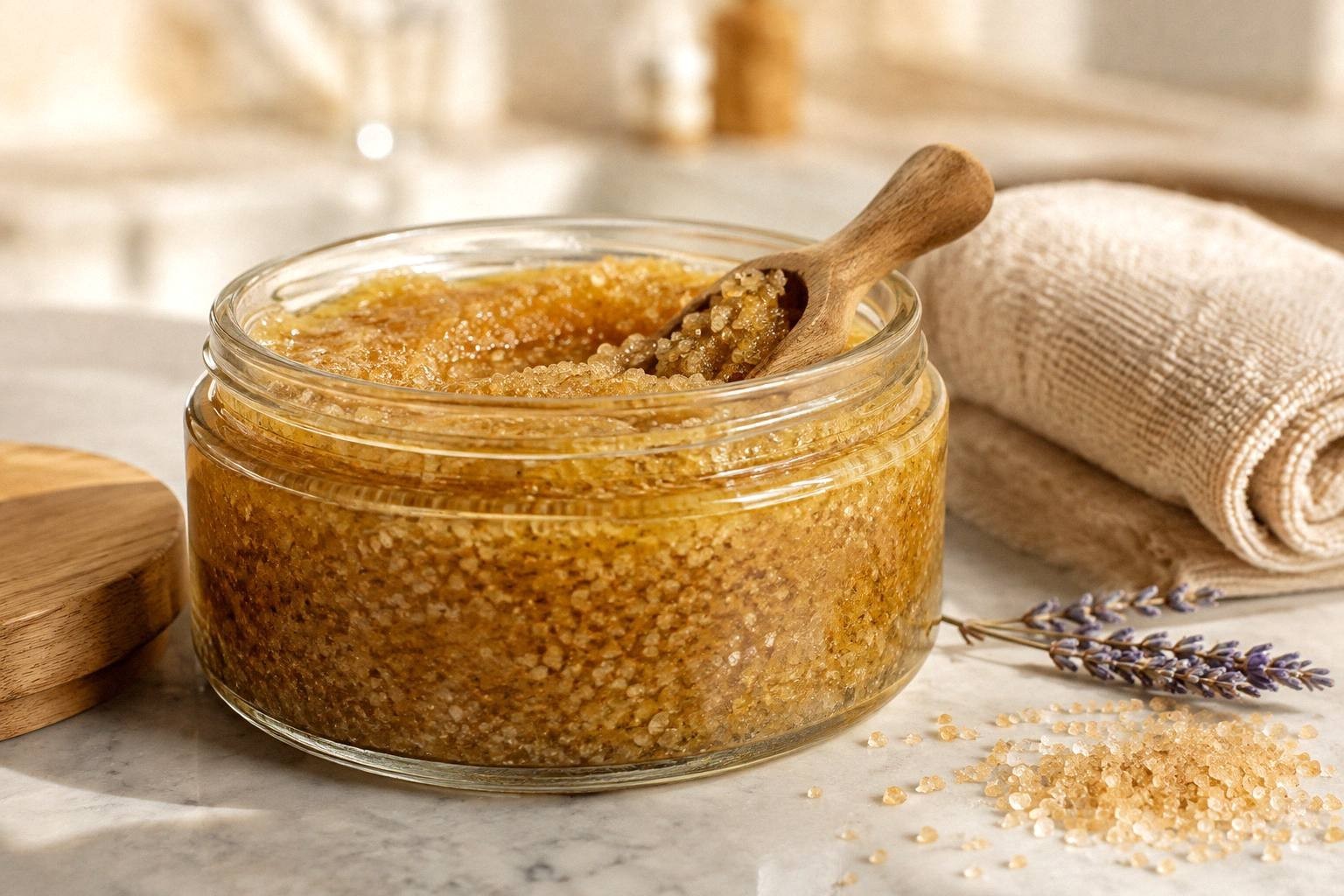
Sugar and oil. Roughly two parts sugar to one part oil, stirred until it holds together on a spoon.
That is a complete DIY body scrub and it is not a simplification. Every commercial jar is this plus fragrance, an emulsifier so it rinses cleaner, a preservative, and a label.
What follows is the part the recipe cards leave out: what the ratio does and does not control, the one variable that genuinely decides whether your jar is fine in three weeks, and the situation where dermatologists say to put the scrub down.
The Ratio Is About Texture
Two to one gives a scrub that holds together and does not run off your hand. More oil makes it looser and more moisturising, more sugar makes it grittier and drier.
I want to be blunt about this because every sugar scrub recipe online states its ratio like a formula. There is nothing behind those numbers. There is no clinical or safety difference between two to one and three to one; it is a preference about how a paste feels. Anyone presenting their ratio as the right one is inventing that confidence.
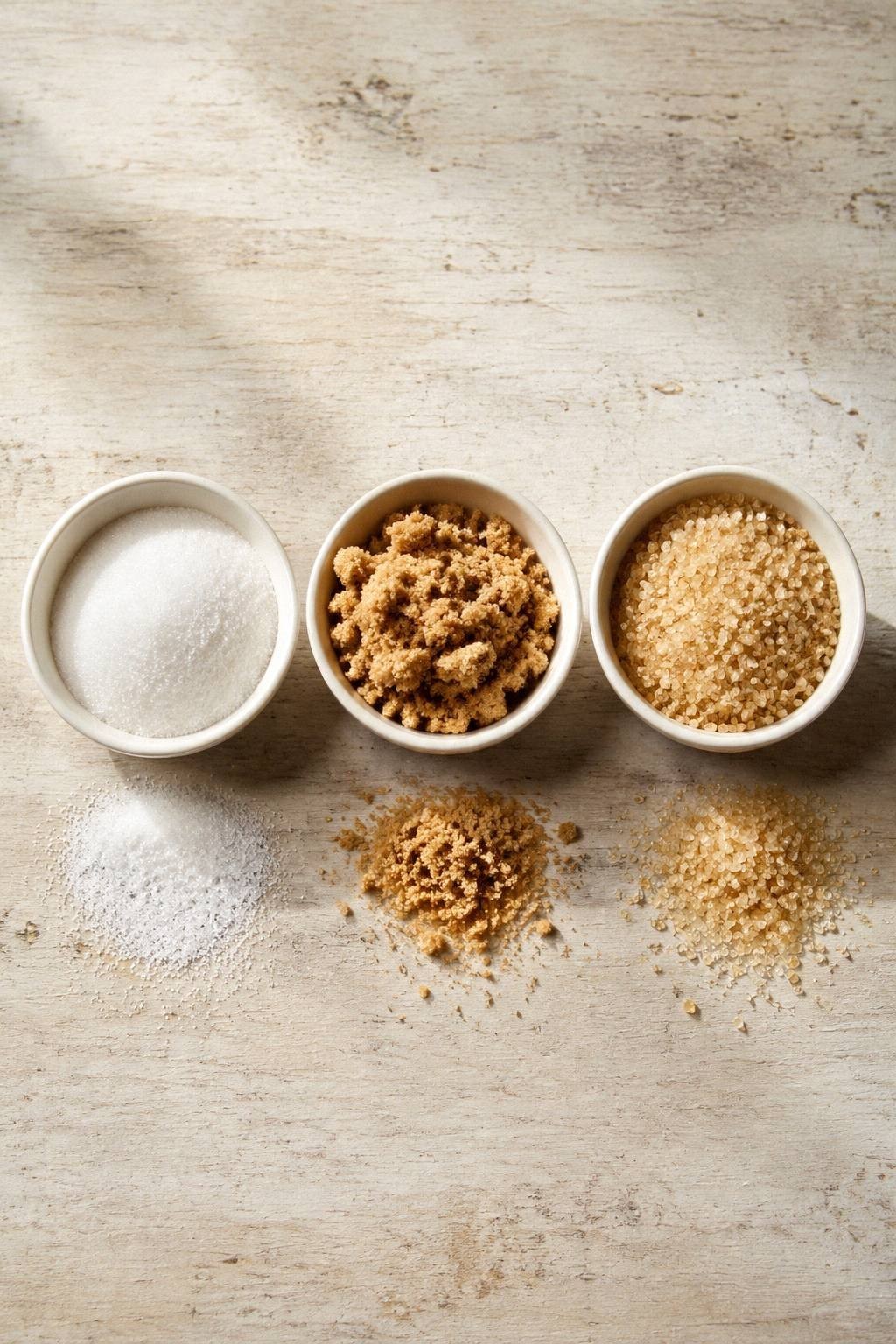
Sugar grade does more than ratio does. Caster or fine white sugar gives a mild scrub. Demerara and raw sugar are coarser and rougher. Brown sugar sits in between and holds more moisture, which matters for the reason below.
The oil is whatever you would already put on your skin: sweet almond, jojoba, sunflower, olive, coconut. Coconut oil is solid below about room temperature, so a coconut oil sugar scrub sets firm in a cold bathroom and softens in a warm one. That is the oil behaving normally, not the scrub failing.
The Variable That Actually Matters
Not the ratio. Water.
Microorganisms need available water to grow, and the measure for it is water activity. The cosmetics industry treats a product at or below 0.75 as low risk on that basis; ISO 29621 lists water activity under 0.75 among the properties that define a microbiologically low-risk product. A true oil and sugar scrub sits in that class, which is why formal preservative challenge testing “is generally not necessary for formulations with aW <0.75”. Sugar itself is one of the ingredients that binds water and pulls that number down.
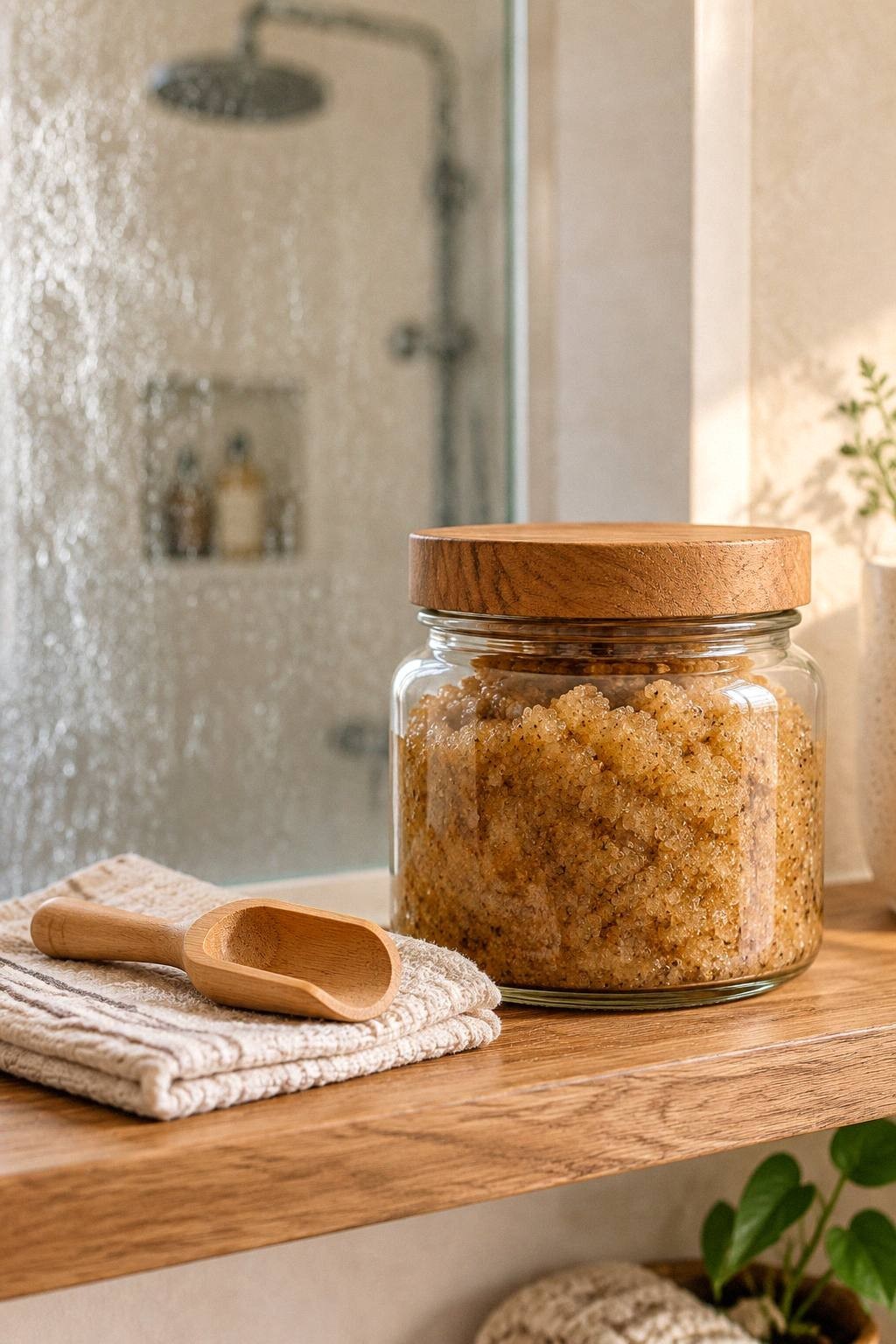
Then the jar goes in the shower, which is the one place in your house that is both warm and wet.
The German Society for Scientific and Applied Cosmetics states the problem directly in its technical paper on water activity:
The utilization of water activity as a preservation technique may also present “in use” microbiological hazards; for instance, when water free formulations, that typically contain fungal or bacterial spores, are subjected to water during use. When the water activity cannot be maintained at a sufficiently low level throughout usage, there is an elevated risk of spore germination.
Dry ingredients commonly carry bacterial spores, which sit inert in oil and wake up when water arrives; germination can begin around a water activity of 0.80, which a wet hand in a jar reaches without trouble. The FDA gives consumers the same instruction in plainer language: do not add water to cosmetic products, because you dilute whatever protection is there, and wash your hands before dipping fingers into a container. It also lists “dipping fingers into the product” as a contamination route in its own right.
So the rules that actually keep a scrub good:
- Scoop before you get in, or keep the jar outside the shower stream
- Dry spoon, never wet fingers. This is the single highest-value habit here
- Small batches. A jar you finish in a few weeks beats a beautiful big one that lives in steam
- Wide, shallow jar so you are not reaching in past your wrist
- Cloudiness or an off smell means it is finished. Oil separating and needing a stir is normal; cloudiness is not
Nobody can give you an honest expiry date for a homemade scrub, and the ones you see quoted are invented. It depends on your bathroom, your jar and your hands.
Herbal Additions Worth Making
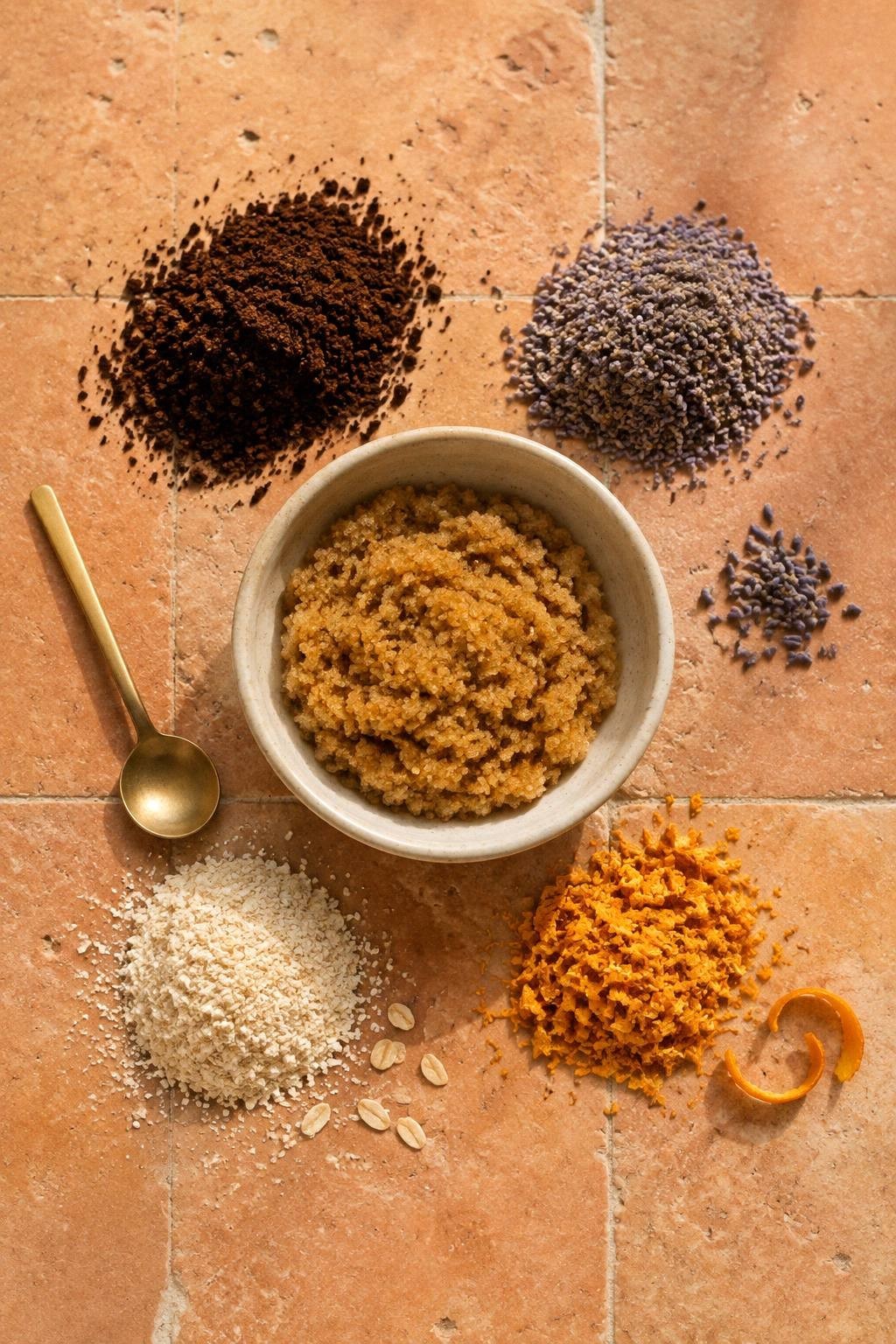
The apothecary versions of this are genuinely nicer than plain sugar, and all of them are dry additions, which keeps the water rule intact.
Coffee grounds. Used, dried thoroughly first. Coarse and vigorous, best on legs and feet. If they are still damp when they go in the jar, you have just added water.
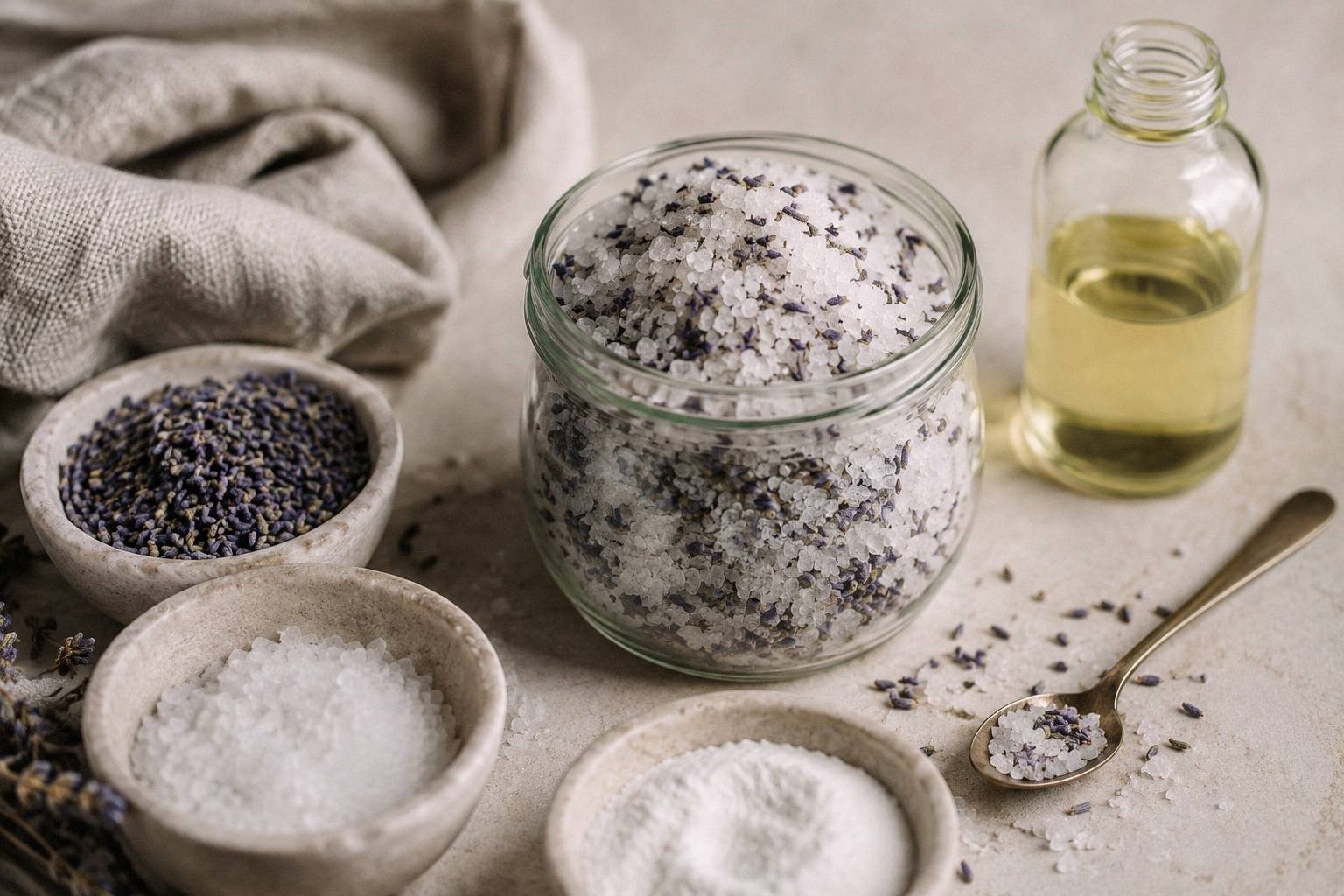
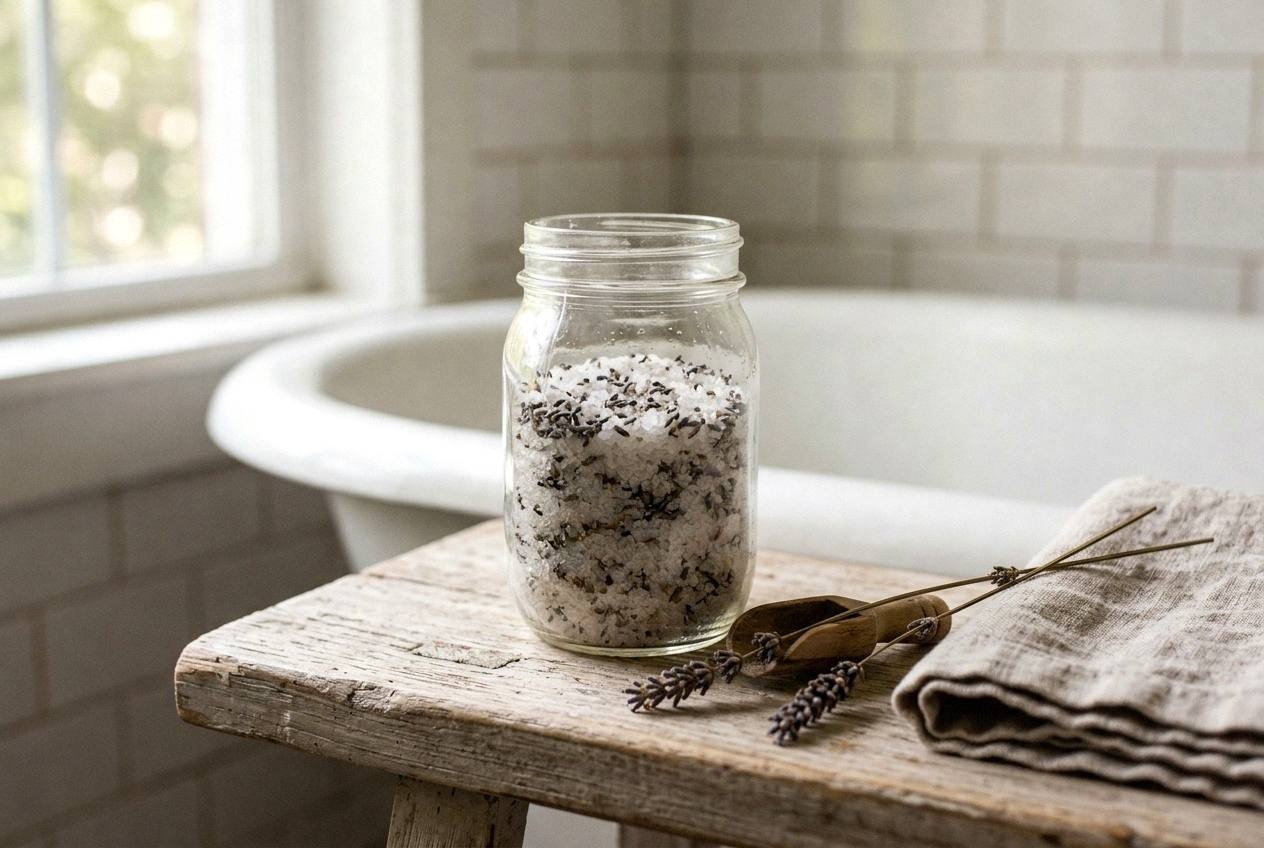
Dried lavender or rose, ground fine. Whole buds do very little except get stuck to you. Ground, they add scent and a small amount of grit. Our lavender bath salts recipe covers sourcing buds that are actually fragrant rather than three years old.
Vanilla bean, scraped. Expensive and worth it in a gift jar.
Ground oats. Softens the whole thing. This is the version to make if the sugar feels too aggressive.
Citrus zest, fully dried. Adds scent without the phototoxicity problem that comes with citrus essential oils, discussed below. Fresh zest carries moisture and belongs in the “do not” list.
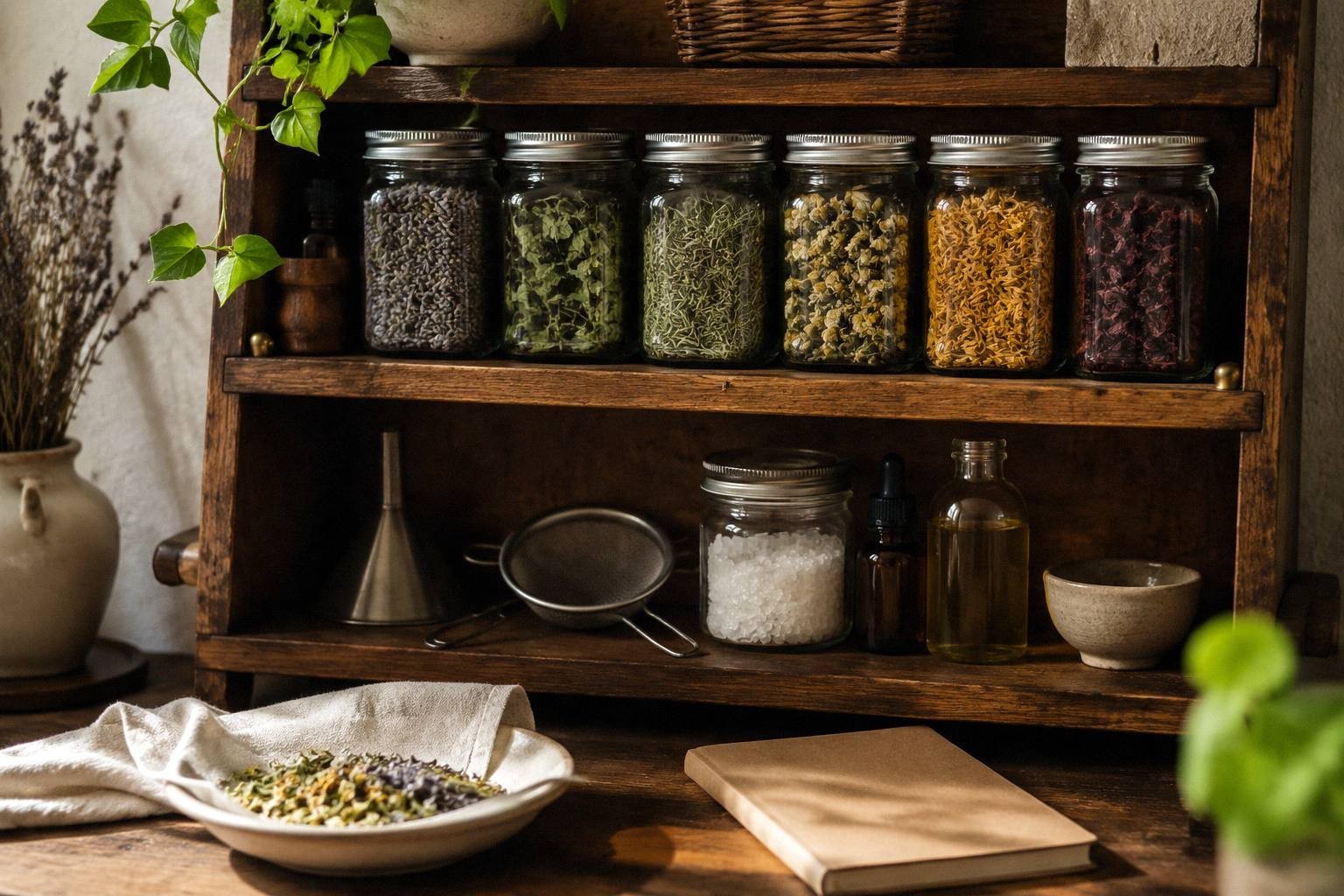
If you already keep a shelf of dried herbs for tea and infusions, most of this is a raid on it rather than a shopping trip. The beginner apothecary shelf covers what is worth keeping.
Essential Oils, With Real Numbers
“Add ten drops of your favourite essential oil” is the standard instruction and it is wrong in a specific way: there is no single safe percentage for essential oils. Limits are set per oil and per product category, which is exactly why a blanket rule cannot exist.
The published figures run well below what home recipes assume. The Cosmetic Ingredient Review puts peppermint oil at 3% or less in rinse-off products and 0.2% or less in leave-on. Real-world industry use of tea tree oil in leave-on products with skin contact tops out near 0.5%. Citrus deserves its own warning: expressed lemon and sweet orange oils have produced phototoxic reactions in people at 1%, and lime at higher concentrations, which is a poor combination with bare legs in summer. Dried zest gives you the scent without that.
Tea tree has one more catch for a jar living in a warm bathroom. Oxidised tea tree oil is a sensitiser, and the CIR panel concluded it is safe as used only when formulated to be non-sensitising. The oil that has been open for a year is not the same material as the oil you bought.
A scrub works perfectly well with no fragrance at all.
Where a Scrub Is the Wrong Tool
Worth saying plainly, because body scrubs get recommended for this constantly and the dermatological advice runs the other way.
Keratosis pilaris, the rough bumps on the backs of arms and thighs, is the condition most people buy a body scrub to fix. The American Academy of Dermatology’s self-care guidance says to slough gently with a loofah, buff puff or rough washcloth and then adds: “Avoid scrubbing your skin, which tends to irritate the skin and worsen keratosis pilaris.” Its recommendations lean on chemical exfoliants instead, the alpha hydroxy, glycolic, lactic, salicylic, urea and retinoid family. If that is what you are treating, a sugar scrub is the wrong purchase and a more aggressive one is worse than a gentle one.
The AAD’s general exfoliation rules apply to the body as they do to the face. Never on sunburned skin or over open cuts. Go gently or not at all if you have a darker skin tone or tend to get dark marks after irritation, because the irritation is what leaves the mark. And on frequency it deliberately gives a proportion rather than a number: the more aggressive the exfoliation, the less often it should happen. Any “twice a week” on a scrub page was made up by the person writing it.
Is Body Skin Really Tougher Than Facial Skin?
Partly, and less uniformly than the marketing suggests.
Measured by confocal Raman spectroscopy, the stratum corneum runs about 16.8 micrometres on the cheek against 22.6 on the forearm and 29.3 on the back of the hand, with the palm out on its own at 173. So the face genuinely is thinner than the forearm, by a modest amount.
But histology across 71 volunteers found the shoulder at 11.0 micrometres, thinner than the dorsal forearm at 18.3, and the buttock at 14.9. “Body skin is thick” is an average that hides a lot. The scrub you would happily use on your heels is not automatically right for your shoulders or your chest.
One more thing worth knowing before you scrub in the shower: hydration alone increases stratum corneum thickness up to twofold within ninety minutes. Skin that has been under hot water is a different substrate from dry skin, and it is softer than whatever you tested on your dry forearm.
Common Questions
What is the best sugar for a body scrub?
Depends how rough you want it. Caster and fine white sugar are mild, demerara and raw sugar are coarse, brown sugar sits in between. There is no sourced comparison ranking them for skin outcomes, so anyone telling you one is objectively best is guessing. Choose by feel and go finer if in doubt.
Sugar or salt?
Both work and no head-to-head study exists comparing them as scrub abrasives. Salt dissolves more slowly and tends to feel rougher, and it stings noticeably on shaving nicks and broken skin, which is the practical reason most people land on sugar for legs.
How long does a homemade sugar scrub last?
While it stays genuinely dry, it is a low-risk product. Once water gets in, no honest number exists. Make small batches, keep a dry spoon in reach, and go by smell and appearance rather than a date somebody invented.
Can I use a body scrub on my face?
A coarse body scrub is harsher than anything the AAD suggests pointing at facial skin, and the face is measurably thinner than the forearm. If you want to scrub your face, make a finer version for it. Our homemade face scrub covers what the evidence does and does not support there, including the sugar-on-your-face claim, which turns out to be folklore.
Why did my coconut oil scrub go rock hard?
Coconut oil is solid below roughly room temperature. In a cold bathroom the jar sets firm and in a warm one it loosens. Stand it in warm water for a minute or stir it. This is not spoilage.
Do I need a preservative?
Not while the scrub is genuinely water free, which is the whole reason the water rules above matter. Adding anything wet, aloe juice, hydrosol, brewed tea, fresh zest, changes that and puts you in preservative territory properly rather than optionally.
Should I moisturise after?
The oil left behind does a fair amount of that work, which is a real advantage of an oil scrub over a foaming one. Pat dry rather than rubbing, and add moisturiser while skin is still slightly damp if you need it.
Where These Numbers Come From
Water activity thresholds, ISO 29621 and the in-use spore quotation come from the German Society for Scientific and Applied Cosmetics technical paper on water activity in cosmetic products . The instruction not to add water and to wash hands before dipping fingers is the FDA’s page on microbiological safety and cosmetics .
Exfoliation rules and frequency are the American Academy of Dermatology’s, from how to safely exfoliate at home , and the keratosis pilaris guidance is from its self-care page .
Stratum corneum thickness by site is from Egawa, Hirao and Takahashi and Sandby-Møller et al. ; the hydration effect on thickness is from the first of those. Peppermint oil limits are CIR and citrus phototoxicity is CIR’s citrus peel oils report .
None of this is medical advice. Skin that is painful, broken, infected or changing quickly needs a clinician rather than a jar of sugar.