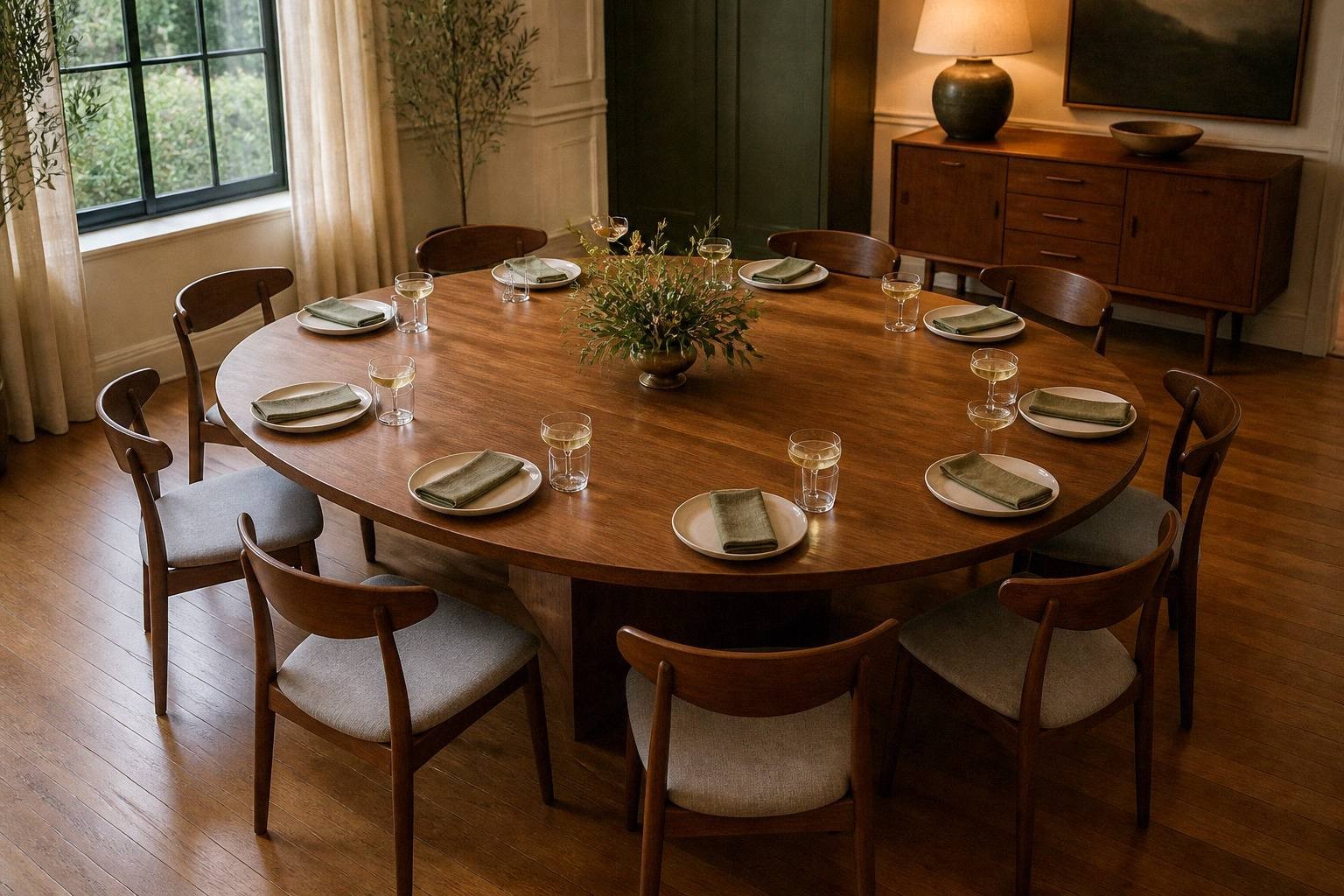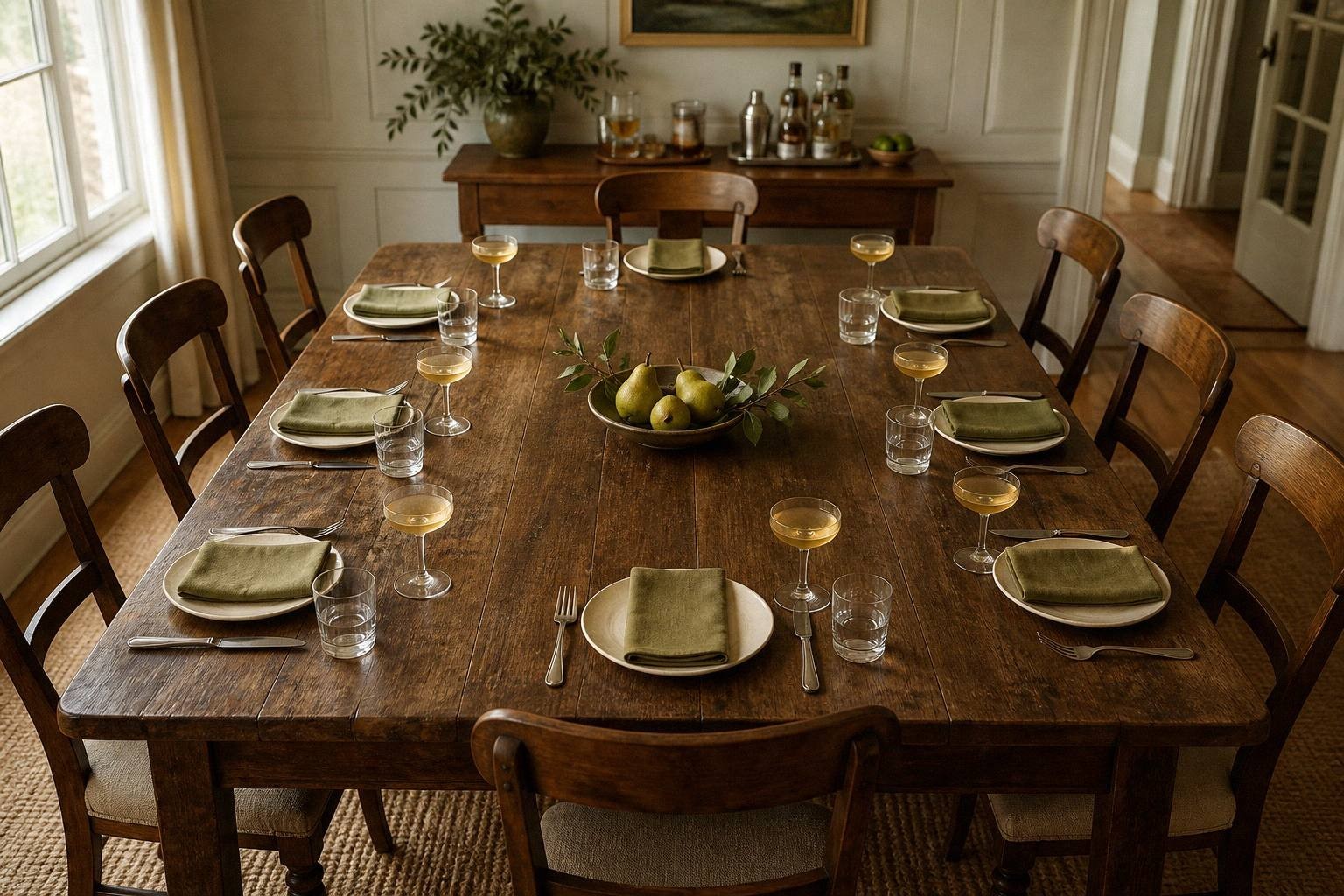
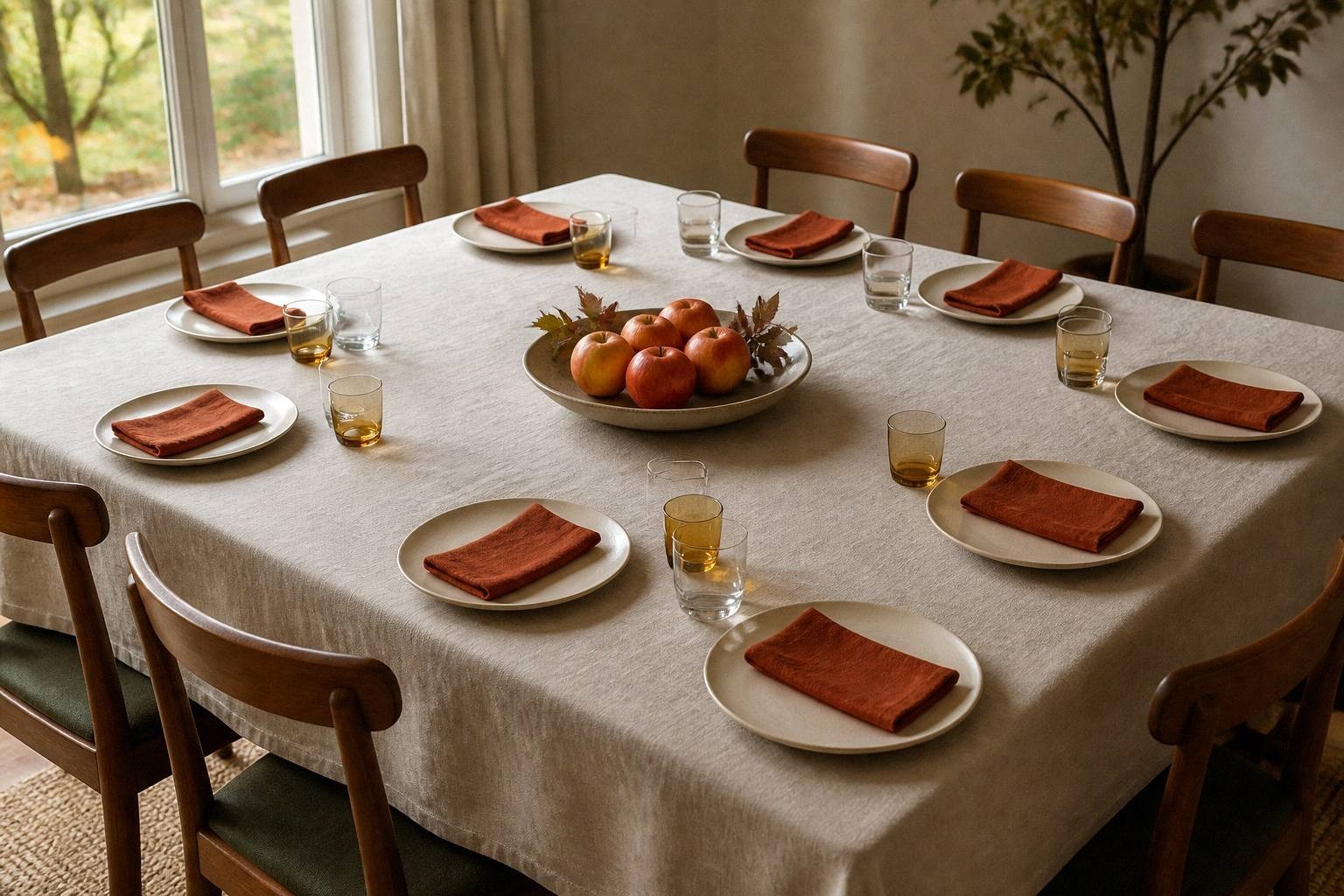
A fall table does not need a cart full of pumpkins. Start with five visual layers: one quiet textile, the plates you already use, cloth napkins, useful drinkware, and one low seasonal centerpiece. Flatware is still part of the meal, but it is working equipment rather than a sixth decorating layer.
The result feels warm because texture, glass, and one concentrated bit of fall color repeat across the table. It also leaves room for the cider, cocktails, and food.
The five-piece fall table formula
| Core piece | Use this | What it does |
|---|---|---|
| 1. Quiet textile | Tablecloth, runner, or bare wood with placemats | Creates one calm background |
| 2. Everyday plate | White, cream, stoneware, or a simple pattern | Gives every seat the same anchor |
| 3. Cloth napkin | Rust, olive, ochre, brown, or natural linen | Carries most of the seasonal color |
| 4. Useful drinkware | Water glass plus the glass the menu needs | Makes the drink part of the setting |
| 5. Low centerpiece | Bowl, tray, or short vase | Concentrates the fall story in one place |
You need eight plates for eight guests, of course. “Five pieces” means five repeatable visual categories, not five physical objects for the whole party.
1. Choose the quiet base first
If the table has warm wood you like, leave it bare and use simple placemats. If it is a folding table or the finish competes with the dishes, use one solid or softly textured cloth. The base should make the food easier to see, not become the loudest pattern in the room.
Utah State University Extension’s table-setting guidance suggests an even cloth overhang of at least 4 inches and generally no more than 10 to 15 inches. Measure the tabletop, then add twice the desired drop to both dimensions. A 36-by-72-inch table with a 10-inch drop needs a cloth about 56 by 92 inches:
36 + 10 + 10 = 56 inches wide
72 + 10 + 10 = 92 inches long
That is shopping math you can use before an online “standard rectangle” arrives two inches above the chair seats. See the Utah State University Extension handbook .
2. Let the everyday plates be the pattern break
Plain plates are useful here. They give a patterned runner, amber glass, or bowl of pears somewhere quiet to land.
Put each plate about an inch from the edge of the table. A full cover is roughly 20 to 24 inches wide and 15 inches deep according to Utah State University Extension’s study guide . Mark those widths with folded napkins before setting the plates if the chairs are not evenly spaced.
Do not buy fall dishes unless you already wanted another full set. A leaf-shaped plate may look seasonal, but eight ordinary plates with rust napkins look like one deliberate table and work again in November, January, and April.
3. Put the season in the napkin
Napkins are the easiest place to use a deeper fall color because they repeat at every seat without taking over the center. Fold each into a loose rectangle and place it to the left of the fork or across the plate.
Choose one color that already appears in the room or the menu:
- Rust with apple and bourbon drinks
- Olive with herb-forward cocktails
- Ochre with pear, ginger, or cider
- Brown with coffee or chocolate drinks
- Natural linen when the glassware carries the color
Skip complicated folds. A napkin should open without shaking acorns, ribbon, or a place-card ornament into someone’s lap.
4. Make the drinkware earn its place
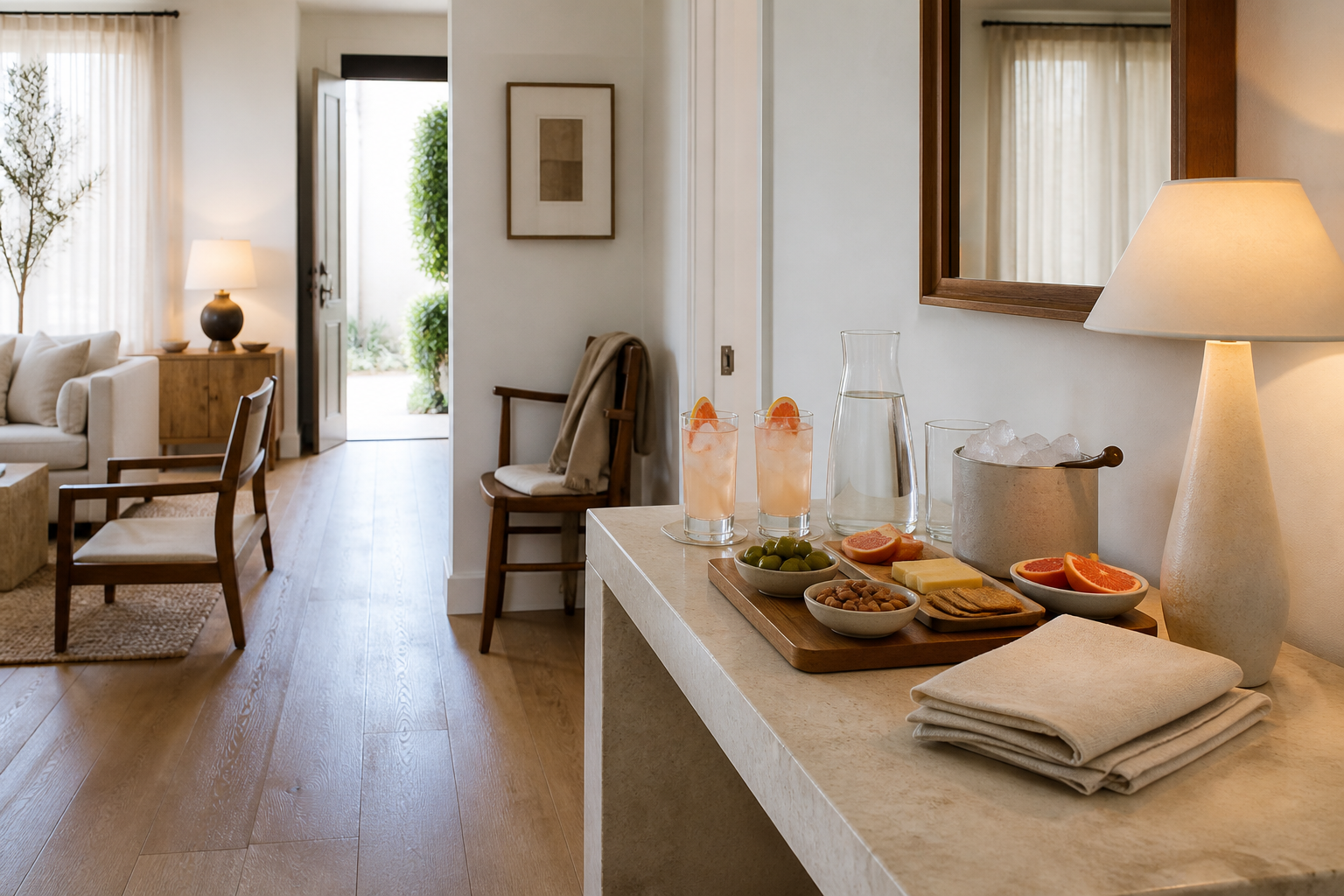
Water belongs at every setting. Add only the glass the first drink needs: a wine glass, coupe, rocks glass, highball, or mug. Backup glasses can wait on a finished serving tray away from the seated table.
For a fall menu, the drink can carry as much color as the centerpiece. An apple cider sangria brings amber fruit and sliced apples. An autumn harvest punch can live on the separate drink table while one finished glass sits at each place.
If you use vintage or thrifted glasses, repeat a material or silhouette instead of demanding a matched set. Eight clear stems of similar height will read as a family even when their etched patterns differ.
5. Build one low centerpiece
Start with a vessel you already own: a shallow bowl, a small serving tray, or three short jars grouped tightly enough to read as one piece. Fill it with a restrained mix such as pears and leaves, small apples and rosemary, or clipped branches with two votive-size lights.
The centerpiece passes when seated guests can see across it and reach their water without brushing it. Sit down to test it. If you have to lean around the arrangement, remove height before adding anything else.
Fresh leaves and paper place cards do not mix safely with open flame. The U.S. Consumer Product Safety Commission advises keeping burning candles in sight, on a stable heat-resistant surface, and away from decorations, curtains, and furniture. Use candles only when an adult can supervise them; otherwise leave them unlit or choose a safe alternative suitable for the household.
Three versions from the same five pieces
The no-buy table
- Bare wood or a plain household cloth
- Everyday white plates
- Neutral cloth napkins
- Clear water glasses and the cocktail glasses you own
- A serving bowl filled with apples and clipped leaves
The thrifted-glass table
- Natural linen runner
- Cream stoneware plates
- Olive napkins
- Mixed etched coupes plus clear water glasses
- A silver or wood tray with pears and short greenery
Keep the table’s other surfaces quiet so the glasses get their moment.
The cider-night table
- Warm brown cloth
- White plates
- Rust napkins
- Heat-safe mugs plus water glasses
- One low bowl of red apples and cinnamon-colored leaves
Keep a protected refill surface nearby for the warm drink. The dining table should hold the mug being used, not the ladle, pot, bottles, and garnish inventory.
How much center space do you really have?
Two 15-inch-deep covers on opposite sides use about 30 inches of table depth.
| Table depth | Space after two 15-inch covers | Styling decision |
|---|---|---|
| 36 inches | About 6 inches | Use one very slim arrangement; serve food elsewhere |
| 40 inches | About 10 inches | One narrow bowl or a line of short pieces can fit |
| 42 inches | About 12 inches | A low tray may fit if glasses and serving reach still work |
This is planning arithmetic based on the Extension cover depth, not a guarantee that every plate and chair combination will fit. Build one real setting and measure it before you buy the centerpiece.
What not to add
The table is finished after the fifth layer. These are the things most likely to make it feel crowded:
- A charger under a dinner plate that already has enough presence
- A second glass for a drink that is not being served yet
- Tiny pumpkins at every place
- Tall branches that split the conversation
- Scattered leaves between working dishes
- A decorative sign that tells nobody what is in the punch
- A second runner crossing the first one
If a piece does not help someone eat, drink, find their seat, or feel the season, it has to earn unusually scarce space.
A 20-minute setup order
- Lay the base and make the overhang even.
- Mark each 20-to-24-inch cover with a folded napkin.
- Place plates and necessary flatware.
- Add water and one menu-specific glass per guest.
- Put the low centerpiece down last.
- Sit in two opposite chairs and test the view and reach.
- Remove one thing before deciding the table needs another thing.
Keep cold cheeses, cut fruit, and dips off the table until close to serving. FoodSafety.gov’s fall guidance recommends cold food stay cold and suggests putting food out in batches so perishables do not sit beyond the two-hour limit.
Common questions
Do fall table settings need a tablecloth?
No. Bare wood, a runner, or placemats can be the quiet base. Use a cloth when the table needs protection, the surface is distracting, or you want to hide a folding table.
What color makes a table look like fall without orange?
Olive, ochre, brown, burgundy, and natural flax all read as fall when paired with warm food, glass, and seasonal branches or fruit.
Can I mix glassware?
Yes. Repeat one feature, such as clear glass, a similar stem height, or one etched style. Put the same practical water glass at each place to keep the mixture grounded.
Where should serving food go?
On a sideboard, buffet, or in small passed waves when the center lane is narrow. Our cocktail-party table for eight shows how table depth changes that decision.
Five layers are enough
Use one calm base, the plates you already own, a seasonal napkin, the glass the drink deserves, and one low centerpiece. The repetition makes the table feel considered. The empty space lets it function.
And when the last guest leaves, almost everything can go back into regular life instead of a labeled fall-decor bin.