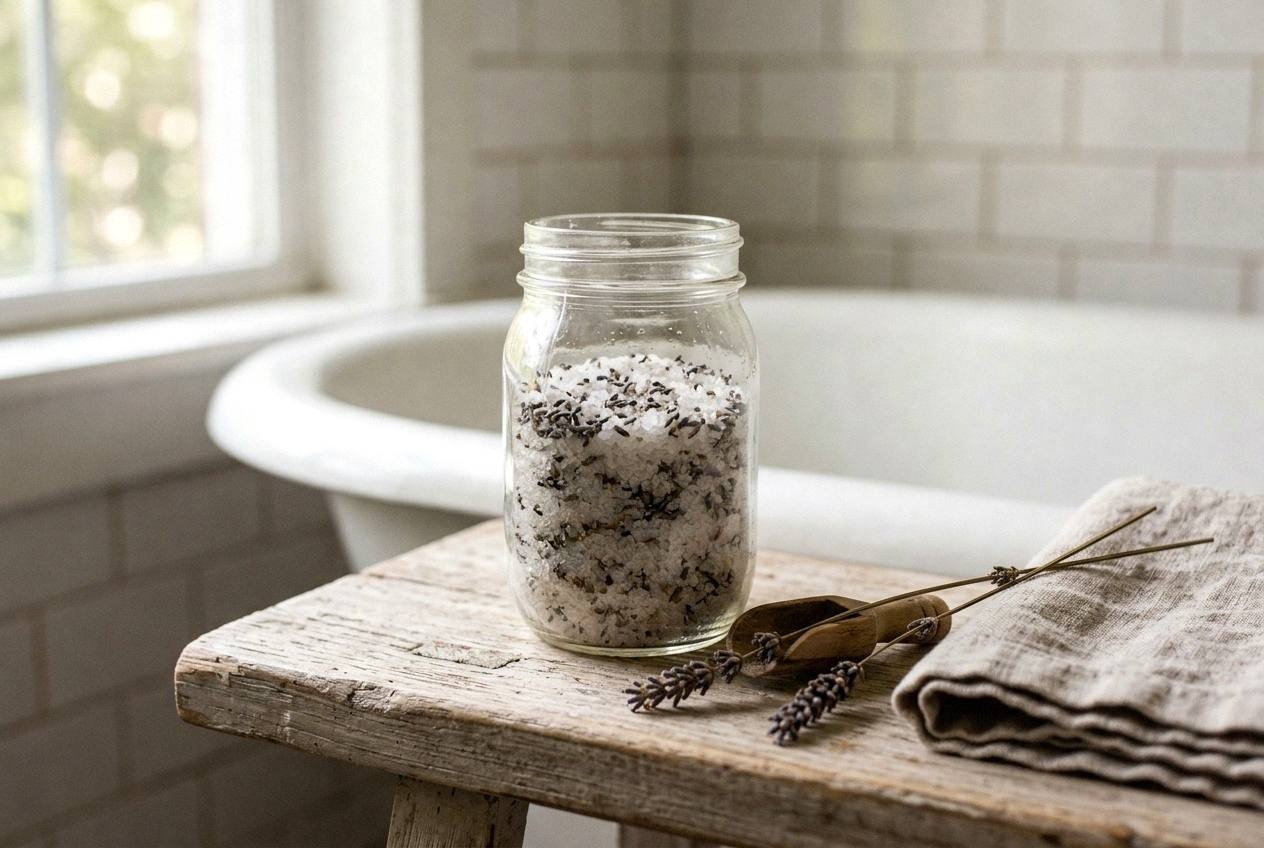
There is a thirty-second window when lavender bath salts do their best work. You tip a half cup into a hot tub, the salt hits the water, and the steam picks up the oil. The room smells like a hedgerow in July before you even sit down. The buds drift toward the edge of the water. Your shoulders start to drop before your skin notices the warmth.
This is one of the simplest things in an apothecary kit. Salt, dried lavender, a measured amount of essential oil, and a small carrier oil to bind it. The whole batch comes together in fifteen minutes. The hard part is restraint, because lavender essential oil rewards a light hand.
If your last jar smelled good for two days and then faded, read the storage companion: how to keep lavender bath salts smelling good . This page is the main recipe. That page is the scent and storage fix.
At a Glance
| Detail | Info |
|---|---|
| Prep time | 15 minutes |
| Yield | About 2.5 cups, roughly 4 to 5 baths |
| Difficulty | Beginner |
| Container | One pint glass jar with a tight lid |
| Per-bath dose | 1/2 to 1 cup |
| Shelf life | 6 months in a cool, dark cupboard |
| Water-free | Yes |
| Preservative needed | No, if kept dry |
Why Lavender Belongs in a Soak
Lavender (Lavandula angustifolia) has been used in Western herbalism as a nervine for centuries. Traditional herbalists, including Rosemary Gladstar , describe lavender as a gentle relaxant for the nervous system , often called on at the end of the day to ease tension and prepare the body for rest. The European Medicines Agency monograph on lavender essential oil lists traditional use for the temporary relief of mental stress and to aid sleep, while still noting that this is traditional use, not a clinical claim.
In a hot bath, the oil volatilizes into the steam, and the warm water relaxes muscle tension on its own. Whether the lavender adds anything chemical is a fair question, and herbalism does not need to oversell here. The scent matters. The ritual matters. Both are real.
Lavender is also one of the gentler essential oils for topical use, which is part of why it shows up in so many home apothecary recipes. That said, “gentle” is not the same as “limitless.” It still needs to be diluted before it touches skin.
Ingredients
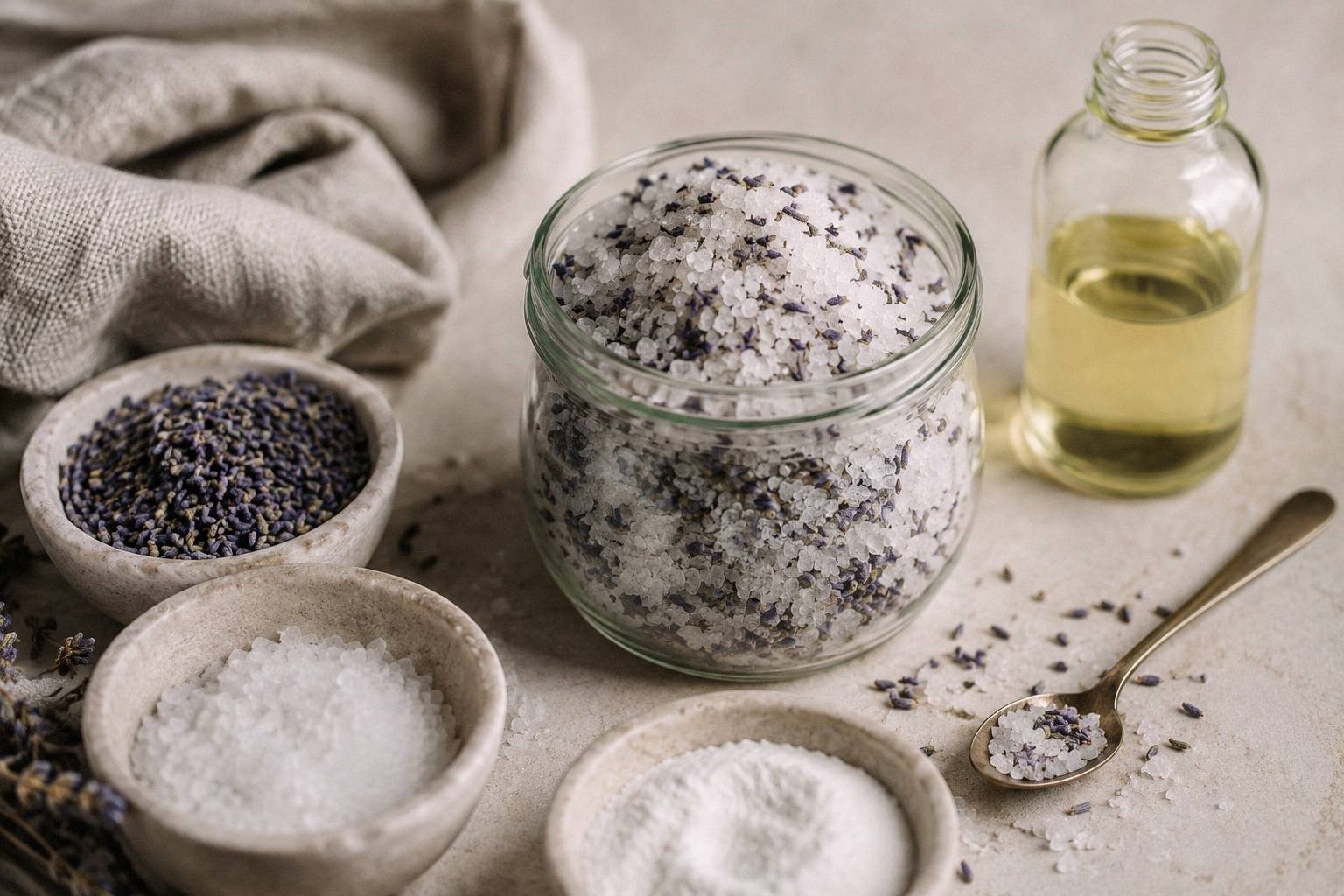
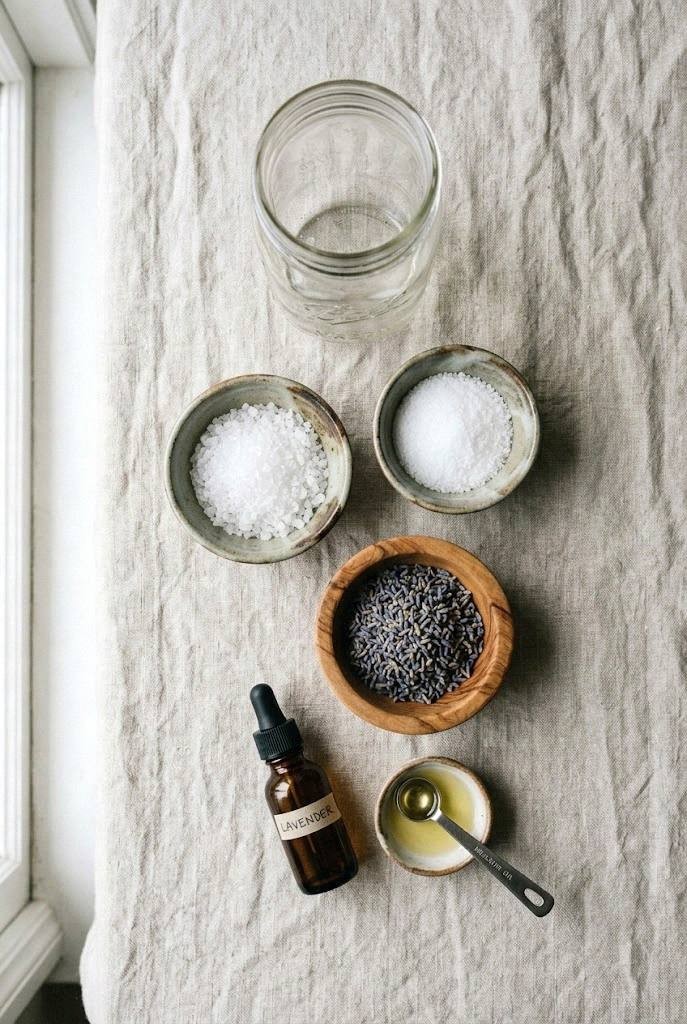
- 2 cups Epsom salt (magnesium sulfate)
- 1/2 cup fine sea salt or Himalayan pink salt
- 1/4 cup dried lavender buds, culinary or English lavender
- 20 to 30 drops lavender essential oil
- 2 teaspoons sweet almond oil or fractionated coconut oil
- 1 tablespoon dried rose petals or chamomile flowers, optional for visual depth
Epsom salt vs sea salt. Epsom salt is the bulk of the recipe because it dissolves quickly in hot water and gives the soak a soft, slippery feel. Sea salt or Himalayan salt adds a little visual texture and a small amount of trace minerals, but the main reason to include it is that it stays distinct as it dissolves, which makes the jar look like apothecary instead of laundry supplies.
English lavender vs French lavender. Mountain Rose Herbs and most home herbalists call for English lavender (Lavandula angustifolia) buds for skin and bath products because the scent is softer and the chemistry is friendlier to skin than French or Spanish lavender. Culinary-grade lavender is fine. If it is clean enough to put in a shortbread cookie, it is clean enough for a bath.
Essential oil grade. Look for therapeutic-grade or 100 percent pure lavender essential oil. The label should list the Latin name and ideally the country of origin. Fragrance oils are not a substitute here. They are synthetic, and they do not behave the same way on warm skin.
Carrier oil. This is the small but critical ingredient. The Tisserand Institute is clear that salt does not properly disperse essential oils in bathwater. The safer construction is to blend the essential oil into a carrier oil first, then mix the oil-and-oil blend into the salt. The salt still carries the scent visually and aromatically, but the carrier is what helps the essential oil move through the water once it dissolves.
Make the Master Recipe
- Combine the Epsom salt and sea salt in a large mixing bowl. Stir with a wooden spoon to break up any clumps. Glass and stainless steel work better than plastic, which can hold onto essential oil scent.
- In a small dish, measure the carrier oil. Add 20 to 30 drops of lavender essential oil and stir for a few seconds. The two oils should look uniform.
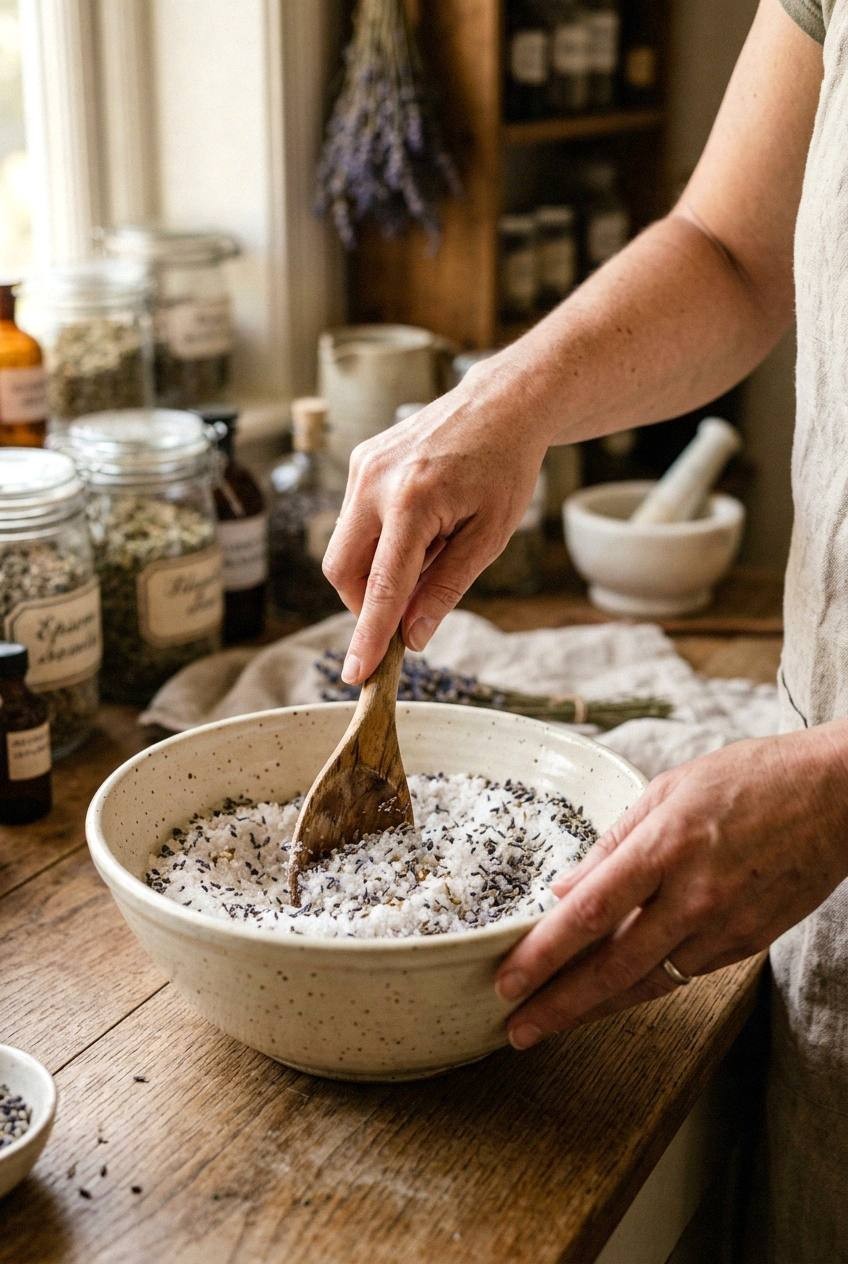
- Pour the oil blend over the salts. Stir slowly and steadily. The salt should hold the oil and feel slightly damp, not wet. If you see oily clumps, keep stirring until they break apart.
- Add the dried lavender buds. Fold them in gently so they stay whole and visible. If you want a little extra color, fold in dried rose petals or chamomile flowers now.
- Spoon the salts into a clean, dry glass jar. A wide-mouth pint jar fits the full batch with a little headspace.
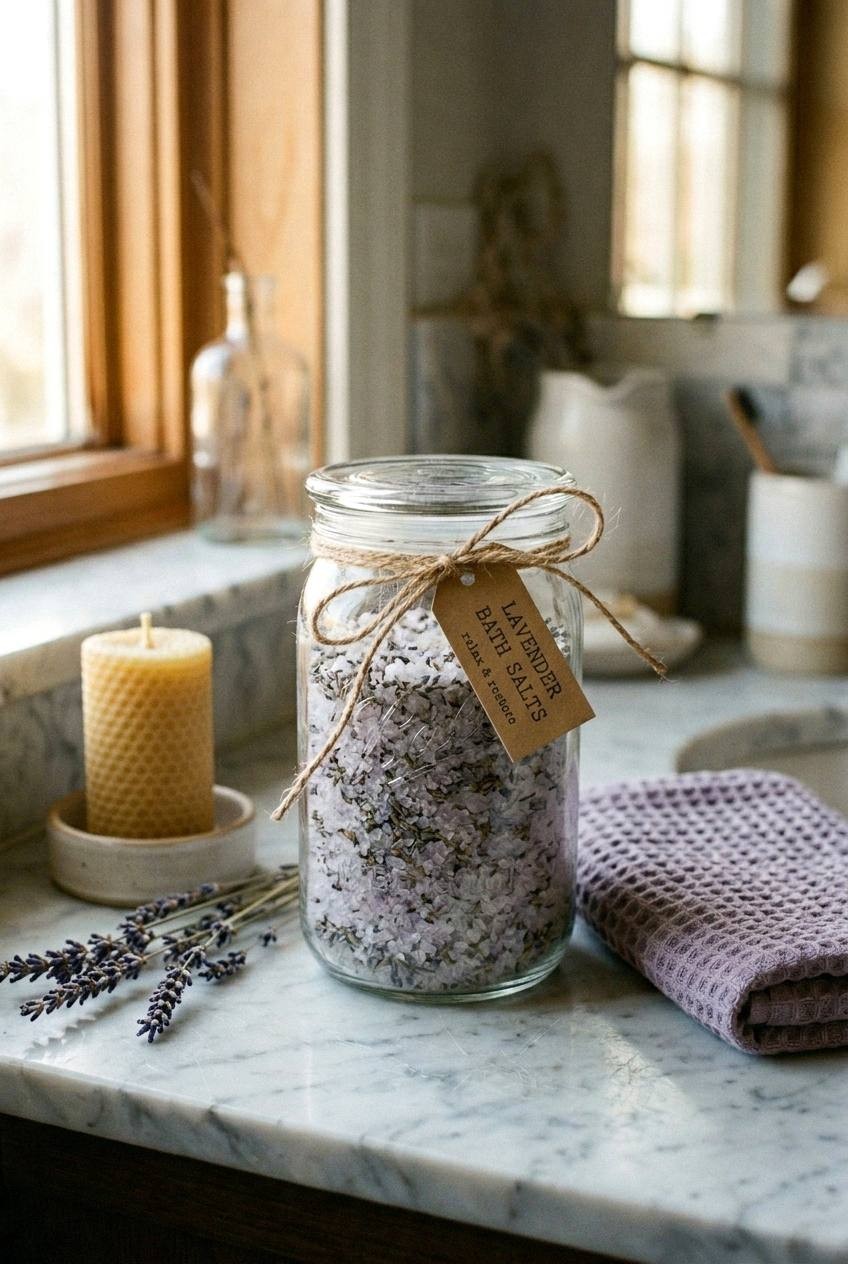
- Seal the jar, label it with the date, and let it sit for 24 hours before the first use so the scent settles into the salt.
Three Variations
The master recipe is the one to learn first. After that, the same base takes a few different turns depending on what kind of bath you want.
Skin-Soothing Variation
Add 1/4 cup colloidal oatmeal or coconut milk powder to the salt mix at step one. Colloidal oatmeal is finely ground oats, and the American Academy of Dermatology Association notes it has a long history of use for dry, itchy skin. Keep the lavender essential oil on the lower end at 20 drops so the bath stays gentle. This version is good for dry winter skin or after a long day in the sun.
Muscle-Soak Variation
Replace 1/2 cup of the Epsom salt with magnesium chloride flakes, sometimes labeled as magnesium bath flakes. Add 5 to 10 drops of peppermint essential oil to the carrier oil along with the lavender, keeping the total essential oil count at 30 drops or less for the full batch. Peppermint gives the soak a cool, post-hike feel. Skip the peppermint if you are sensitive to menthol or have very reactive skin.
Sleep Variation
Swap 2 tablespoons of the dried lavender for 2 tablespoons of dried chamomile flowers. Reduce the lavender essential oil to 15 drops and add 5 drops of cedarwood (Atlas or Virginian) essential oil to the carrier. Cedarwood is grounding and slightly woody, and it leans the whole jar toward bedtime instead of afternoon. A drop or two of vanilla CO2 extract is nice here if you have it, though it is not strictly an essential oil.
Essential Oil Safety in the Tub
A few things worth being honest about.
The Tisserand Institute’s official position is that salt is not a true dispersant. Adding essential oil directly to dry salt and stirring will scent the salt, but in the bath, the oil can release as small undispersed droplets that float and cling to skin. That is why this recipe blends the essential oil into a small amount of carrier oil first. It is not perfect dispersion, but it is meaningfully safer than oil-on-salt alone.
A 1 percent dilution is a common target for general adult skin contact. For a full 2.5 cup batch used at 1/2 to 1 cup per bath, 20 to 30 drops total works out conservatively in that range once the salts dissolve into a tub of water. If you have very sensitive skin, start at 15 drops and try the bath before scaling up.
Skip essential oils, or talk to a qualified practitioner first, if you are pregnant, nursing, or making a soak for a child or infant. Lavender is on most “generally regarded as safe” lists for adults, but bath products for babies are a different category, and many herbalists recommend keeping essential oils out of an infant’s bath entirely.
Do not use this on open wounds, broken skin, or freshly shaved legs. Patch test on an inner forearm if you have a history of skin sensitivity. If the scent feels too strong in the tub, get out, rinse with cool water, and use less next time.
Storage and Shelf Life
Store the jar in a cool, dark cupboard with the lid sealed tight. Heat and light degrade essential oils faster than time alone. A bathroom counter that gets steam every morning is the worst spot. A linen closet, a bedroom shelf, or a kitchen cupboard away from the stove all work better.
The salts will keep their scent for about 6 months. After that, they are still fine to use, but the lavender note fades and the bath turns into a mostly mineral soak. If you make a big batch as gifts, plan to give them out within a few weeks of mixing so the recipient gets the brightest version.
If moisture sneaks into the jar, the salt will clump. A small clump is fine, just break it up with a fork. If the salt looks wet, slimy, or starts to smell off, throw it out. Dry salt is the whole game.
How to Use the Salts
Plug the drain before the water starts so nothing washes down. Sprinkle 1/2 to 1 cup of salts into the tub once there is a couple of inches of water, then let the rest fill on top. The salt dissolves fast in moving water.
Some lavender buds will float. If you do not love picking damp flowers out of the drain, drop the dose into a muslin tea bag and the buds stay contained. A 20-minute soak is the sweet spot. Rinse with plain water at the end if you used the peppermint muscle-soak variation.
Another Dry Jar Worth Making
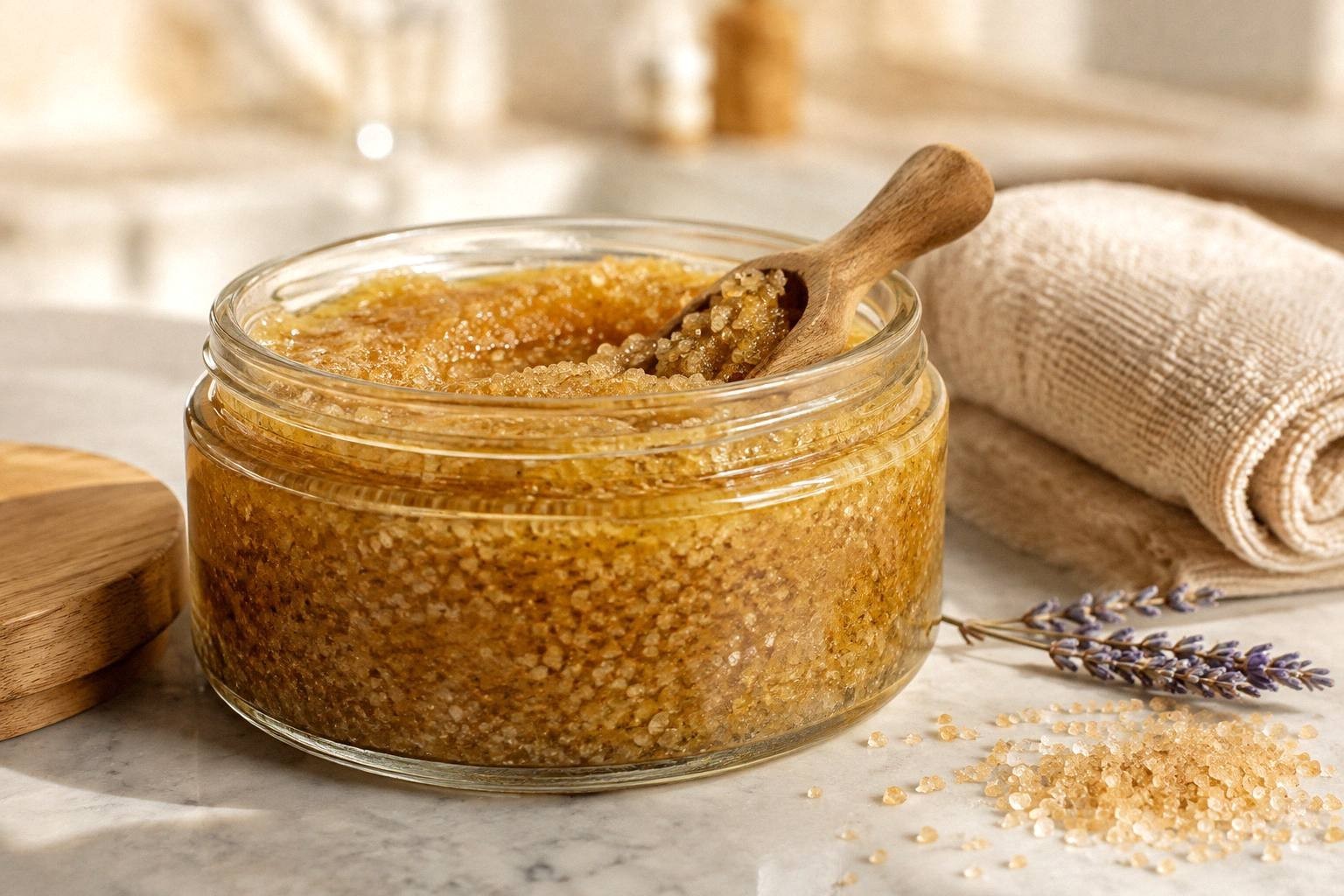
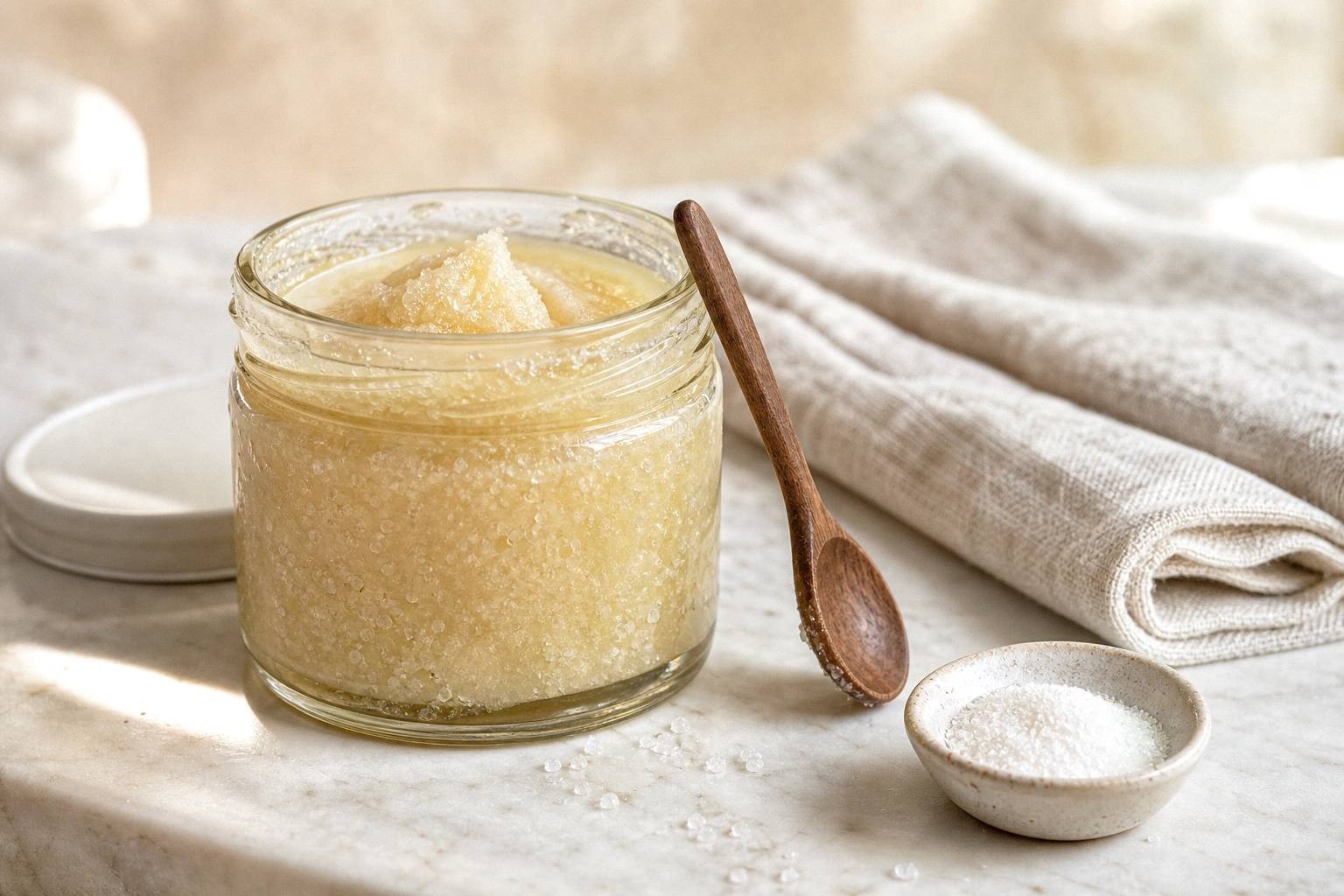
Bath salts and a sugar scrub solve the same storage problem the same way, by keeping water out of the jar. If you already have the lavender and the sealed containers, the DIY body scrub is the next thing to make from that shelf.
Common Questions
Can I use Himalayan pink salt for the whole batch instead of Epsom salt?
You can, but the bath will feel different. Epsom salt is the magnesium-heavy ingredient that gives the soak its soft, muscle-loosening feel. Himalayan salt is mostly sodium chloride with trace minerals. A jar of pure pink salt makes a pretty gift, but it is more scented sea salt than true mineral soak.
Do I need to dry my own lavender?
Not at all. Dried English lavender from a reputable supplier like Mountain Rose Herbs or Frontier Co-op is excellent and saves time. If you grow your own, harvest the buds just before they open, hang the stems upside down in a dark, dry spot for two to three weeks, and strip them once they crumble easily.
Why does my batch smell weak after a week?
Essential oils are volatile. If the jar is not sealed tightly, the top notes evaporate first. Check the lid, store the jar away from heat, and stir a few extra drops of lavender essential oil into a small dish of carrier oil and fold it back through the salts.
Can I add baking soda?
Yes. Some recipes use a 3:1:1 ratio of Epsom salt, fine sea salt, and baking soda. Baking soda softens the water further and is fine for most adults, but skip it if you have very sensitive or compromised skin barriers.
Is this safe for kids?
For older children, about 1/4 cup of plain salts without the essential oil is the conservative call. Many herbalists keep essential oils out of baths for children under six. A separate jar of just Epsom salt, sea salt, and dried lavender buds is a gentle option for a family bath shelf.
Why This Belongs on the Apothecary Shelf
A jar of bath salts is one of the small honest things home herbalism is good at. No cure claims. No marketing language. Just salt, a flower used in baths for a thousand years, a measured dose of oil, and a careful step to keep that oil from misbehaving in the water.
That is the whole apothecary lane. Useful plants, real measurements, restraint with the strong stuff. A jar on a shelf that does exactly what it says it does.