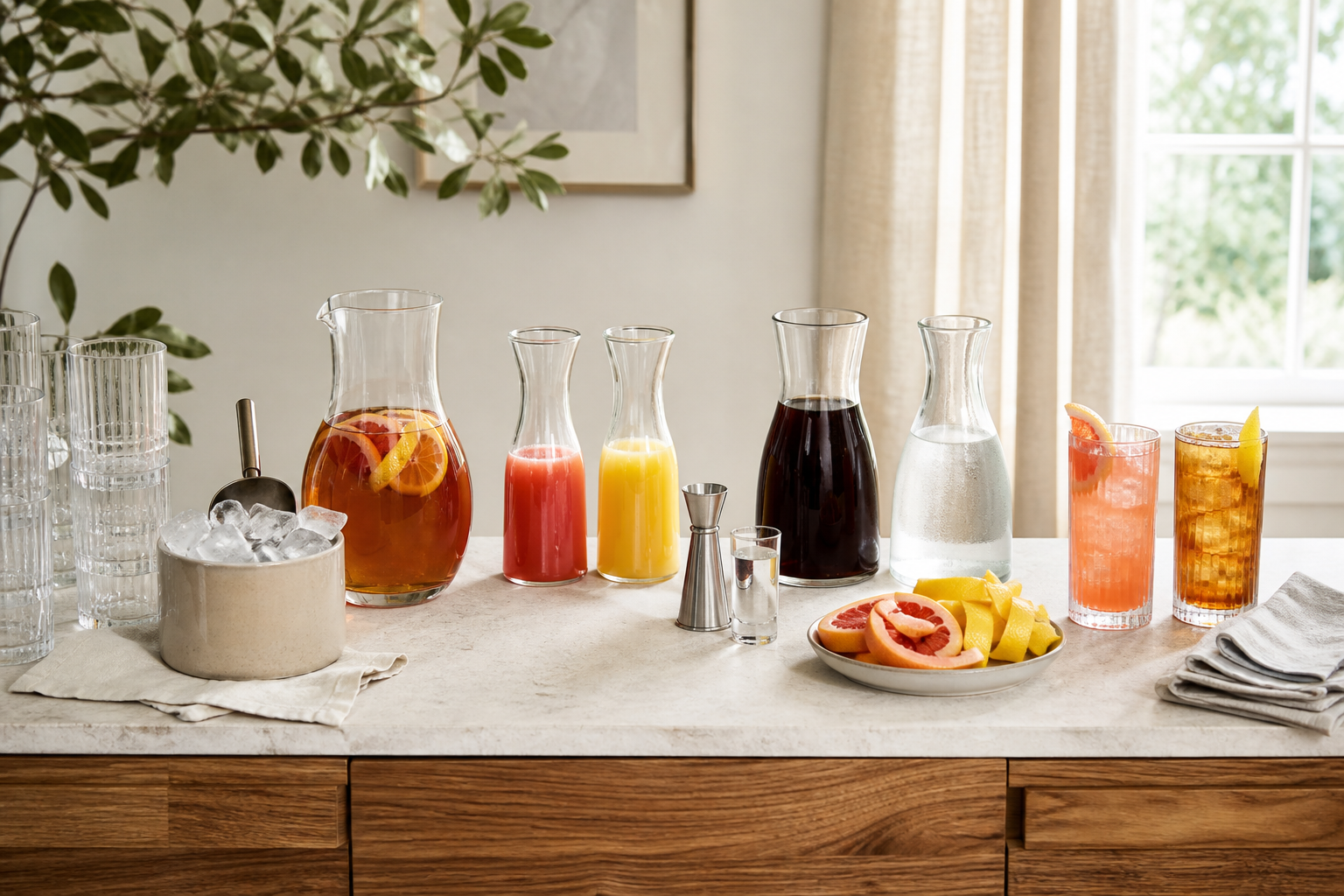
A self-serve cocktail buffet needs fewer choices than a full bar. Use one alcohol-free tea-citrus base, two fruit modifiers, one measured spirit, one equal zero-proof finish, and soda.
Set everything left to right in the order it enters the glass. Guests can make four distinct drinks, but every one follows the same measured build, so the host isn’t trapped behind the table explaining it.
A station is easier to use when the drink choices are planned first; the cocktail party menu without bartending walks through that menu decision.
Keep the buffet to one drink family
The word buffet can tempt a host to put out every bottle, syrup, garnish, and mixer in the house. That isn’t freedom. It is a test nobody knew they were taking.
A useful cocktail buffet gives guests three real choices:
- Grapefruit or pineapple modifier
- Cocktail or zero-proof finish
- Citrus peel or herb garnish
The shared base does the difficult work. It supplies tea, citrus, sweetness, and dilution. The modifier changes the flavor, the finish changes the proof, and the soda gives every glass the same lift.
This page owns the measured cocktail-buffet method. For a general cups-ice-pour-garnish layout without customizable recipes, use the existing drink station ideas guide .
If the ingredients need to live on a cart instead of a table, how to style a bar cart for mocktails and cocktails shows how to keep both finish lanes visible without crowding the working shelf.
The tea-citrus base for twelve drinks
This base makes 24 ounces, enough for twelve 2-ounce portions.
Ingredients
- 12 ounces strong brewed black tea, chilled
- 4 ounces fresh lemon juice
- 4 ounces 1:1 honey syrup
- 4 ounces cold water
For the honey syrup, stir equal volumes of honey and warm water until fully combined. Cool it, then measure 4 ounces for the batch.
Instructions
- Brew the tea at twice your usual strength and let it cool completely.
- Combine the tea, lemon juice, honey syrup, and cold water in a covered 1-quart pitcher or bottle.
- Stir and taste the base cold. It should be bright and slightly concentrated because each glass will receive 4 1/2 ounces of modifier, finish, and soda.
- Refrigerate the covered base until serving. Stir again before it goes on the table.
Don’t add ice or soda to the base. Ice would change its strength while it sits, and soda loses its energy faster in a wide pitcher.
Choose two modifiers, one spirit, and one zero-proof finish
For twelve first-round drinks, prepare:
- 6 ounces pink grapefruit juice in one labeled bottle
- 6 ounces pineapple juice in another labeled bottle
- Gin in its original labeled bottle or a clearly labeled service bottle
- 18 ounces strong chilled black tea for the zero-proof finish
- At least 24 ounces chilled club soda
Six ounces of each juice covers an even six-and-six split. If your guests strongly prefer one flavor, prepare more of that modifier using the same 1-ounce-per-glass ratio.
The tea finish is not an imitation spirit. It adds tannin and body while keeping the zero-proof glass connected to the same drink family. A zero-proof botanical spirit can replace the tea in the same 1 1/2-ounce measure if you already have one and enjoy it.
Gin works with both grapefruit and pineapple, which is why it earns the single spirit lane. Don’t add vodka, rum, tequila, and whiskey for the sake of choice. More bottles create more recipes, less clear alcohol strength, and a slower line.
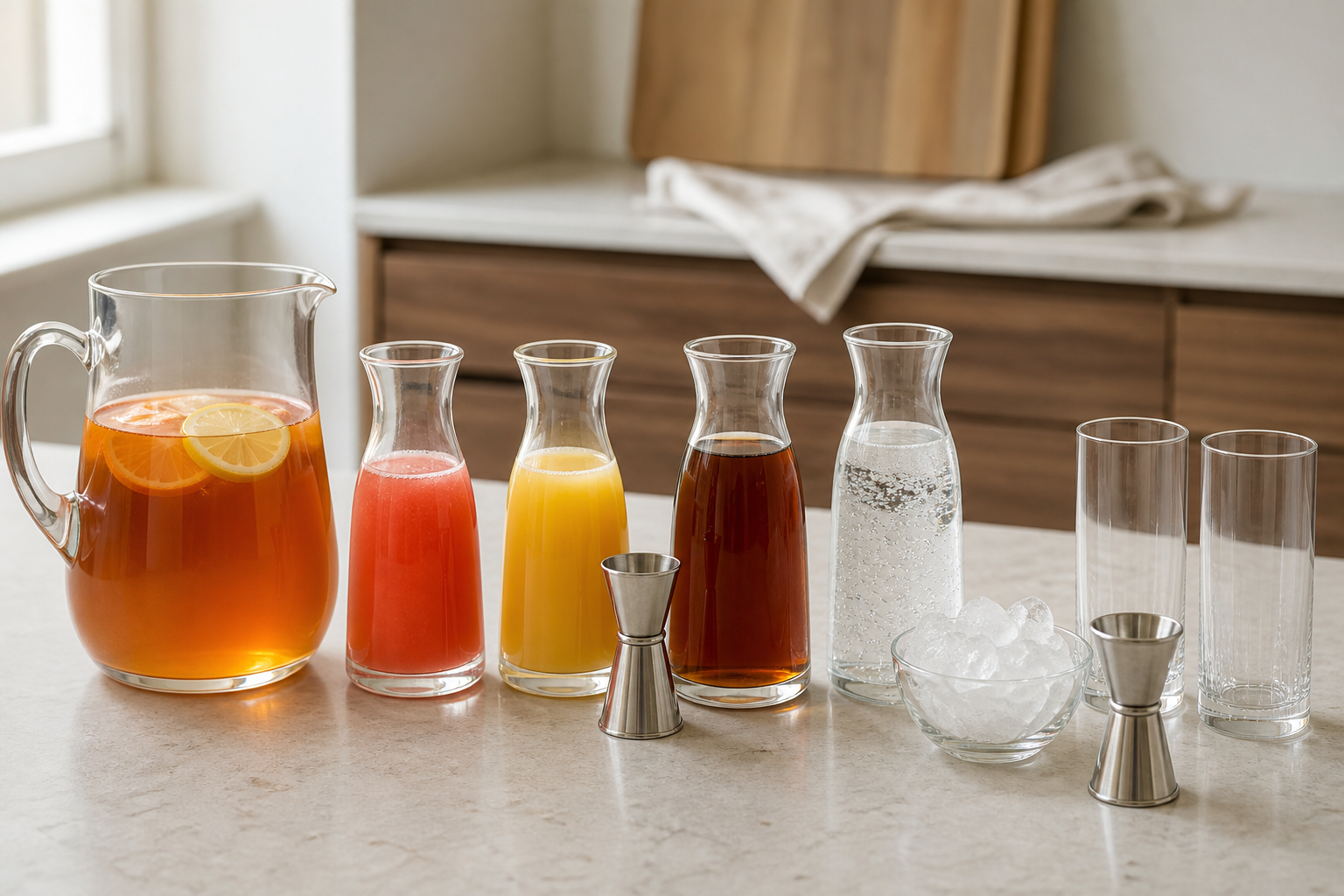
The four measured build cards
Every glass uses 2 ounces base, 1 ounce modifier, 1 1/2 ounces cocktail or zero-proof finish, and 2 ounces soda. The finished drink is 6 1/2 ounces before ice dilution.
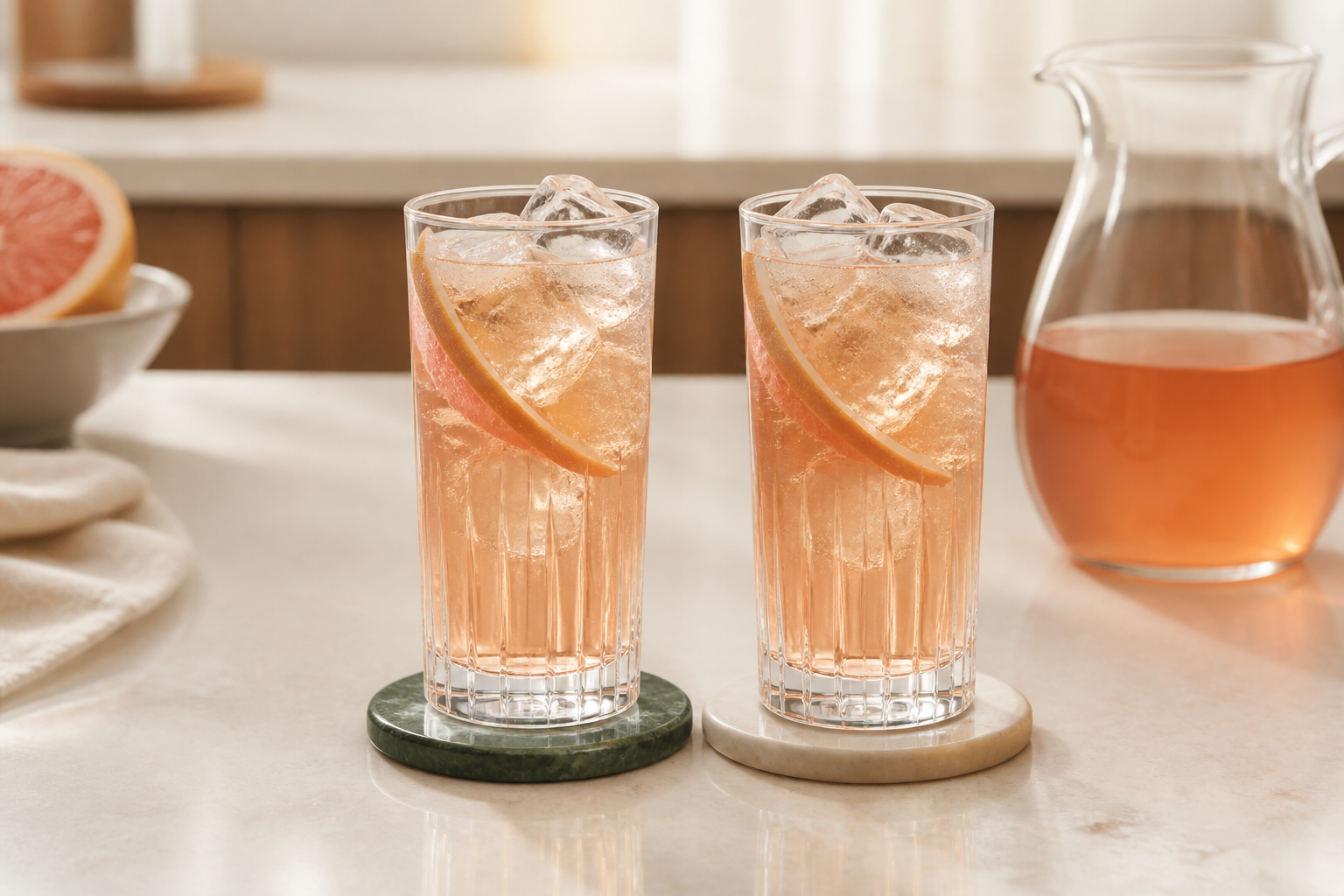
Grapefruit gin highball
- Ice
- 2 ounces tea-citrus base
- 1 ounce grapefruit juice
- 1 1/2 ounces gin
- 2 ounces club soda
- Grapefruit peel
Add ice, base, grapefruit juice, and gin. Stir, top with soda, and garnish.
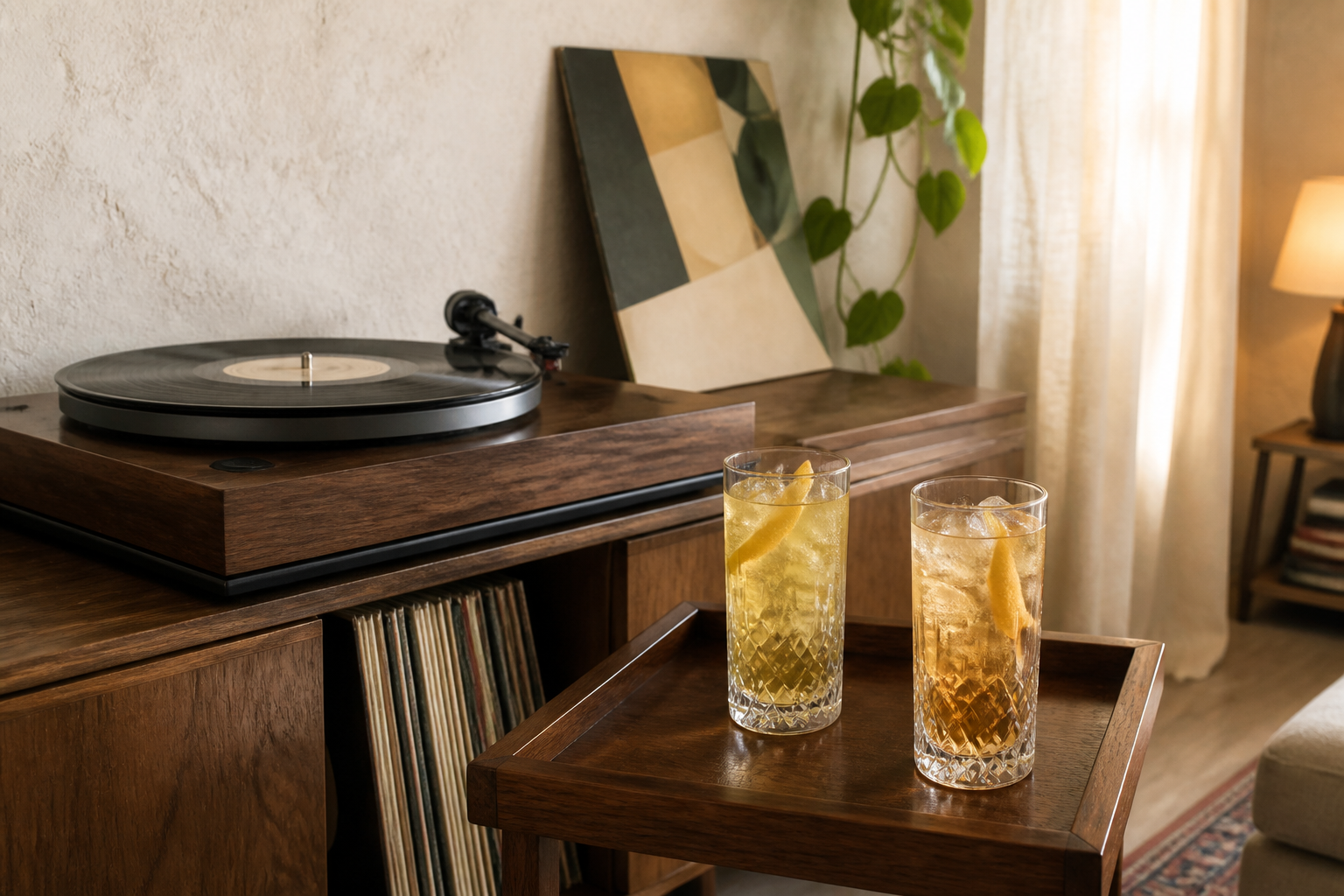
Pineapple gin highball
- Ice
- 2 ounces tea-citrus base
- 1 ounce pineapple juice
- 1 1/2 ounces gin
- 2 ounces club soda
- Lemon peel or one small rosemary sprig
Add ice, base, pineapple juice, and gin. Stir, top with soda, and garnish.
Grapefruit tea highball
- Ice
- 2 ounces tea-citrus base
- 1 ounce grapefruit juice
- 1 1/2 ounces strong chilled black tea
- 2 ounces club soda
- Grapefruit peel
Build it exactly like the cocktail. The same ice, glass, soda, and garnish keep it from looking like the afterthought.
Pineapple tea highball
- Ice
- 2 ounces tea-citrus base
- 1 ounce pineapple juice
- 1 1/2 ounces strong chilled black tea
- 2 ounces club soda
- Lemon peel or one small rosemary sprig
The pineapple version is softer and rounder; grapefruit stays drier and brighter. Those two modifiers create enough contrast for a real choice without asking guests to understand a shelf of ingredients.
Set the station in build order
Arrange the buffet from left to right:
- Glasses
- Ice and scoop
- Tea-citrus base with a 1-ounce measure nearby
- Grapefruit and pineapple modifiers
- Gin and chilled tea finishes with a 1 1/2-ounce measure
- Club soda
- Two garnishes
- Napkins, water, and a small discard bowl
One 1-ounce measure handles the 2-ounce base in two fills and the 1-ounce modifier in one. A separate 1 1/2-ounce jigger stays with the finish lane. If the measures look too similar, tie a small piece of colored twine to one handle or use clearly different styles.
Keep the zero-proof finish beside the spirit, not at the far end near the water. Equal placement tells guests both builds are part of the buffet.
Give the station enough room for one person to build while another waits without leaning over the ice. If the table is narrow, put glasses and ice on a small side surface, then begin the recipe at the base.
Write build cards people can follow
Don’t make guests read a paragraph. Use two large cards, one for each finish:
MAKE IT A COCKTAIL 2 base + 1 grapefruit or pineapple + 1 1/2 gin + 2 soda
MAKE IT ZERO-PROOF 2 base + 1 grapefruit or pineapple + 1 1/2 tea + 2 soda
Under both cards, add: “Numbers are ounces. Use the matching measures.”
Place the cards upright behind the bottles, not flat under condensation. Keep the ingredient labels visible for guests with allergies or preferences. If you change an ingredient, update the card rather than telling the first three people and hoping the news travels.
Measure the alcohol instead of hiding it
The gin build uses 1 1/2 ounces per glass. The NIAAA standard-drink guide explains that 1.5 fluid ounces of 80-proof distilled spirits contains one U.S. standard drink. A higher-proof gin or any additional alcohol changes that amount.
Use a jigger and keep the full recipe visible. A self-serve setup should make strength easier to understand, not turn the spirit bottle into an invitation to free-pour.
Stock the spirit according to the number of cocktails you expect:
cocktail servings × 1.5 ounces = spirit ounces needed
For six cocktails, set out 9 ounces. For twelve, set out 18 ounces. Keep the rest of the bottle off the buffet and refill deliberately if the gathering continues.
Cold water belongs beside the station, with enough glasses for people to use it without taking a cocktail glass out of circulation.
Calculate the first round
For twelve guests making one drink each:
| Item | Amount for 12 drinks | Per drink |
|---|---|---|
| Tea-citrus base | 24 oz | 2 oz |
| Total modifier juice | 12 oz | 1 oz |
| Gin, if all 12 choose cocktails | 18 oz | 1 1/2 oz |
| Chilled tea, if all 12 choose zero-proof | 18 oz | 1 1/2 oz |
| Club soda | 24 oz | 2 oz |
| Finished liquid before ice | 78 oz | 6 1/2 oz |
You don’t need to know the cocktail and zero-proof split in advance if both finishes are available. Calculate gin for the maximum number of alcoholic drinks you intend to serve, prepare an equal number of tea portions, and keep backups cold.
Measure your ice instead of guessing
Fill one serving glass with the amount of ice you want, empty that ice into a measuring cup or bowl on a kitchen scale, then multiply by the number of first-round drinks. Add one-third more as a melt and spill reserve. This uses your real glass and cube size, which is more useful than a universal bag count.
Plan one glass per guest
Give each person one marked highball and a clear place to rinse it between drinks. If you don’t want guests rinsing glasses, provide a second clean set for the next round. A mountain of mixed glassware makes it harder to distinguish active drinks from abandoned ones.
Food safety and cleanup
Fresh juice and brewed tea should stay refrigerated until the station opens. Put out one first-round bottle of each and keep backup base, tea, and juice cold.
The USDA says perishable foods should not remain between 40°F and 140°F for more than two hours, or more than one hour when the temperature is above 90°F. Review its danger-zone food-safety guidance , use smaller refill bottles, and discard a batch that exceeds the limit instead of topping it with fresh liquid.
Put a folded bar towel under the measures and a washable tray under the bottles. Give citrus peels and used stirrers a visible discard bowl. Keep replacement napkins and soda under the table or in the refrigerator, not stacked around the working area.
When the party ends, refrigerate unopened ingredients promptly and discard any poured drink that has been sitting out. Wash the measures, bottle lids, and any pour spouts where juice or syrup can collect.
What to skip
- More than one spirit
- More than two modifiers
- Unlabeled decanters
- Free-pour spouts without a measure
- Loose herbs floating in the base
- A garnish tray with ten choices
- Alcohol hidden in a shared base
- A zero-proof option placed somewhere else
If you want a pretty surface, use a linen runner, one lamp, and the color in the drinks. The recipe parts are already the decoration.
Cocktail buffet checklist
The day before
- Brew and chill the tea.
- Make and chill the honey syrup.
- Print or write the two build cards.
- Choose one spirit and two juices.
- Count glasses and test the station footprint.
Two hours before
- Mix the base and refrigerate it.
- Juice citrus if needed.
- Chill the modifiers, tea finish, soda, and water.
- Cut two restrained garnishes.
- Put the backup ingredients together in the refrigerator.
Just before guests arrive
- Fill the first ice container.
- Set bottles in build order.
- Put each measure beside its job.
- Place the build cards upright.
- Set out water, napkins, a towel, and a discard bowl.
- Make one cocktail and one zero-proof drink from the cards to confirm the table is clear.
Common questions
What is a cocktail buffet?
It is a measured self-serve bar where guests choose among a small set of compatible ingredients. Unlike a full open bar, every choice follows one clear drink formula.
How many options should a self-serve cocktail bar have?
One base , two modifiers, one spirit finish, and one zero-proof finish create four clear drinks. More choices make labels, measures, and alcohol strength harder to manage.
Can I batch the alcohol into the base?
Not if you want cocktail and zero-proof guests to use the same base. Keeping alcohol at the glass makes the choice visible and lets every guest receive the same prepared flavor foundation.
What is the easiest cocktail buffet for a crowd?
Use a tea-citrus base, grapefruit and pineapple juices, gin, strong chilled tea, and club soda. Every drink follows the same 2 + 1 + 1 1/2 + 2-ounce build.
How do I stop guests from free-pouring?
Set out only the amount of spirit planned for the round, place a 1 1/2-ounce jigger beside it, and make the measured recipe larger and easier to see than the bottle label.
The host’s best drink is the one they get to finish while it is still cold. Let the cards explain the buffet, then leave the station and join the party.