
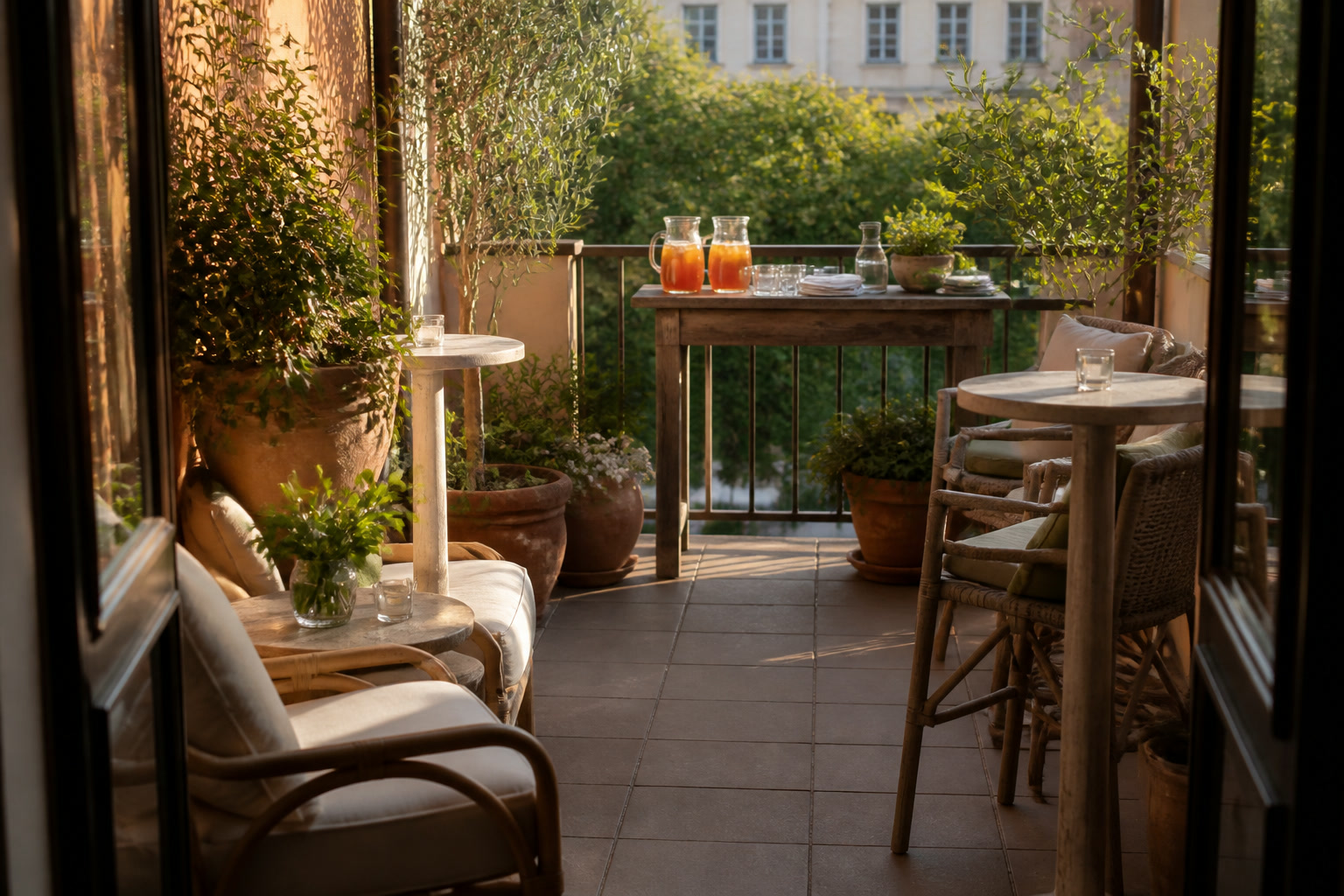
Eight people can have a real cocktail party on a small patio. The trick is not squeezing in eight dining chairs. Keep one clear route from the door to the farthest seat, move drinks away from that route, and give standing guests a place to set down a glass.
For an eight-person first round, two 64-ounce pitchers are comfortable rather than crowded. Filling each to about 85 percent gives roughly 54 ounces per pitcher. At a 6-ounce pour, that is nine pours each, or eighteen total. This is capacity math, not a drinking target. Keep cold water visible, offer a zero-proof choice, and let guests decide what suits them.
Start with the path nobody gets to decorate
Open the patio door and walk to the farthest chair as if you are carrying a full tray. That route stays empty. Do not let a planter, cooler, stool, purse basket, or decorative lantern creep into it.
The doorway deserves special protection because it is the pinch point between the kitchen and the party. A drinks table just outside the door looks convenient in an empty photo. Once guests arrive, it becomes a tollbooth. Everyone stopping for a refill blocks anyone carrying food, collecting glasses, or stepping inside.
Put the drinks against a side wall or rail instead. If the only available wall is beside the door, begin the service zone at least one comfortable body-width beyond the swing of the door. Test the setup with the door fully open.
This guide owns the whole-patio layout. If the real problem is finding a tiny surface for drinks inside an apartment, use the small-space drink station guide instead.
Use two small zones instead of one crowded table
One overfilled table asks every guest to reach into the same square of space. Two smaller zones let the party breathe.
Zone one: the first pour
Put the signature cocktail and zero-proof option together on the most stable surface. The guest should be able to pick up a glass, pour, and step away without crossing another guest’s arm.
Keep this zone lean:
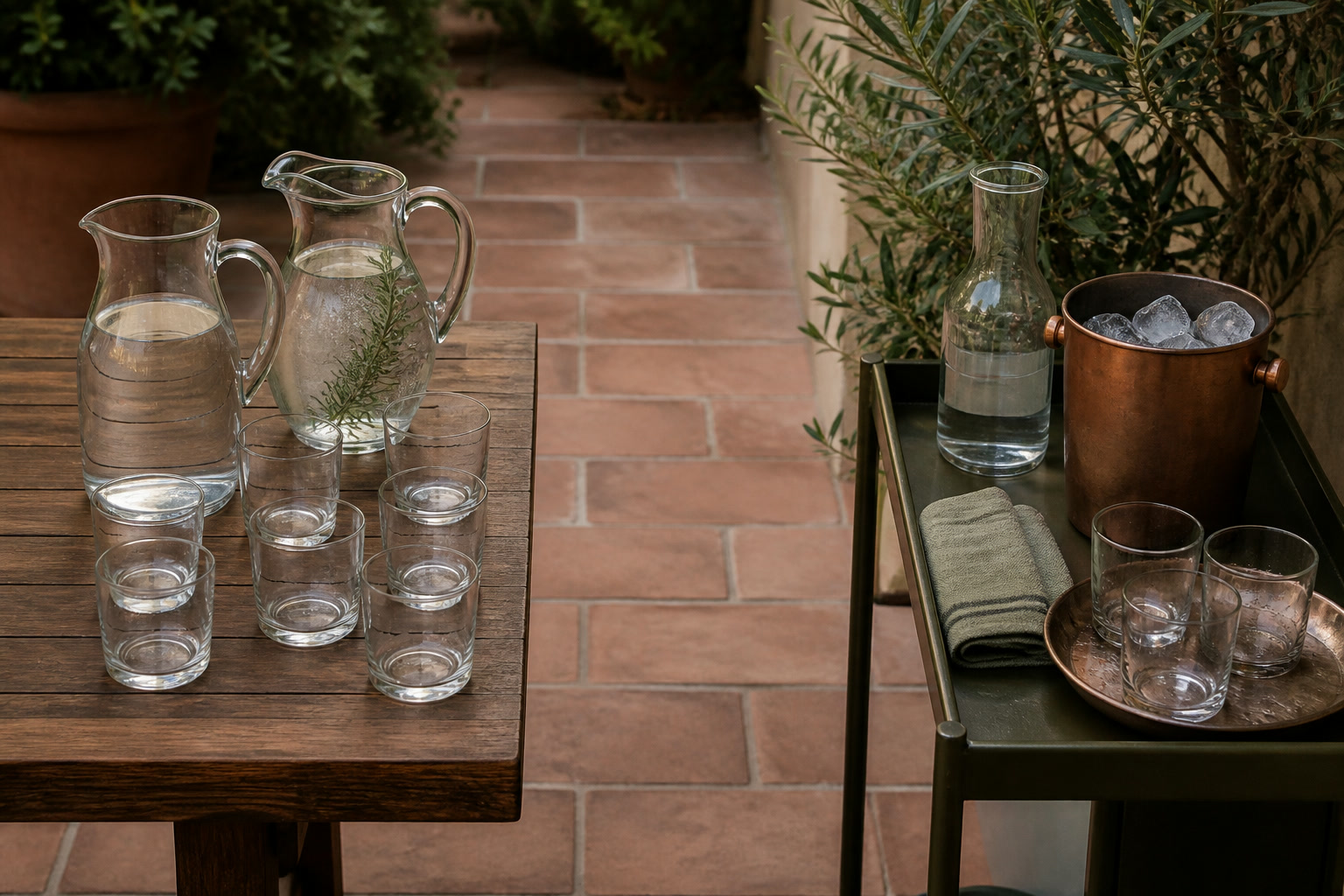
- Two pitchers, one alcoholic and one clearly labeled zero-proof
- Eight to ten glasses, with clean backups inside
- A small drip tray or folded bar towel
- One label for each drink, including major allergens where relevant
- One garnish, already cut and kept cold until the last minute
The FDA identifies nine major food allergens, including milk, tree nuts, peanuts, wheat, soy, and sesame. A home party label is not a substitute for a conversation with an allergic guest, but writing down the ingredients makes that conversation much easier. See the FDA’s food-allergy overview .
Zone two: water, ice, and landing space
Put water near the seating, not underneath the cocktails. Add an ice bucket or small cooler, napkins, and a tray for used glasses. This second zone catches the things that otherwise spread across every chair arm and windowsill.
It also prevents the host from guarding the main drink table . Someone who only wants water should not wait behind someone reading a cocktail label.
Seat four and make room for eight
A cocktail party is not a dinner party. Eight guests do not need eight assigned dining seats unless the gathering includes a seated meal.
For eight people, try:
- Four proper chairs around the perimeter
- One sturdy bench or storage box with a cushion
- Two standing ledges or small tables for glasses
- One indoor chair kept available for anyone who needs back support
Leave the center open. Chairs pushed to the edges create several small conversations and make it easier for people to change groups. A complete dining set in the middle locks everyone into one conversation and consumes the only walking space.
Do not use a folding stool as a drink table if someone may need it as a seat. A tray on a planter is also a gamble unless the planter is flat, heavy, and impossible to tip. Stability beats cleverness outdoors.
The drink math for eight guests
Start with the vessel, the planned pour, and enough headroom to move it safely.
Example:
- A 64-ounce pitcher filled to 85 percent holds 54.4 ounces.
- Round down to 54 ounces so the math does not promise the last splash.
- Divide 54 by a 6-ounce serving.
- One pitcher gives nine full pours.
- Two pitchers give eighteen pours.
That is enough vessel capacity for a first round for eight plus ten additional pours across the two choices. It does not predict what the group will consume. Keep any refill batch cold inside rather than putting every ounce outdoors at once.
If the cocktail uses 80-proof spirits, remember that 1.5 fluid ounces of the spirit contains one U.S. standard drink, according to the National Institute on Alcohol Abuse and Alcoholism . Wine, liqueur, and higher-proof ingredients also contribute alcohol. Write the recipe and serving size beside the pitcher rather than letting a pretty glass hide the strength.
For a larger self-serve table, the complete drink-station guide covers layouts and refill planning. On a small patio, two pitchers are the upper limit I would start with.
Pick a menu that does not create patio chores
Choose one drink that can be batched without ice or carbonation, then finish it when it reaches the table. Put ice in glasses rather than the pitcher so the last pour is not weaker than the first. Add sparkling water immediately before serving, or let guests top their own glasses.
A useful pair looks like this:
- Cocktail: a citrus-tea punch, sangria, or spirit-and-juice batch with a measured serving
- Zero-proof: the same tea or fruit base without alcohol, clearly labeled and visually distinct
Sharing a base cuts prep without making the alcohol-free option feel like an afterthought. A different pitcher shape or label prevents mix-ups. Batch mocktails guests can pour themselves has combinations that work on this scale.
Skip drinks that need egg white, fresh muddling, a blender, or a shaken finish for every order. Those are lovely for two people. For eight people on a narrow patio, they turn the kitchen doorway into a service window.
Keep cold things cold in small batches
Cut fruit, dairy-based dips, and other perishable garnishes should not spend the whole afternoon warming beside the drinks. FoodSafety.gov says perishable food should be chilled or discarded after two hours at ordinary outdoor temperatures, and after one hour when the temperature is above 90°F. Their summer food-safety guidance explains the limit.
For a small party, the easiest approach is to put out one small garnish bowl and replace it from the refrigerator. Do the same with any perishable snack. A small cold refill looks fresher than a large tray that has been outside since the first guest arrived.
A 45-minute setup order
45 minutes before
- Remove anything from the walking route
- Move chairs to the perimeter
- Set the two service surfaces in place
- Put a towel under each pitcher position
- Check that the patio door opens fully
25 minutes before
- Bring out empty glasses and labels
- Set water at the second zone
- Put coasters or two small landing tables near the chairs
- Place a discreet tray for used glasses
10 minutes before
- Bring out the two chilled pitchers
- Add carbonation if the recipe uses it
- Add fresh ice to the bucket or cooler
- Put out the first small bowl of garnish
When the first guest arrives
Pour one example glass and show them where water is. That is enough instruction. If the station needs a speech, it is too complicated.
What to skip on a small patio
- A full bar cart. It occupies floor space and attracts a standing crowd around its shelves.
- Eight dining chairs. The center becomes furniture storage instead of a party.
- Loose paper napkins. One breeze turns them into a scavenger hunt. Use a weighted holder or cloth.
- A garnish buffet. One cold garnish is useful. Six bowls consume the whole table.
- Glass on concrete if the party is lively. Acrylic or sturdy tumblers are the calmer choice.
- The cooler in the doorway. Convenient for exactly one minute, annoying for the rest of the night.
Common questions
How many people can fit on a small patio?
The honest number depends on the patio, furniture, exit path, and whether everyone must sit. Test it with the actual chairs in place. For a standing cocktail party, perimeter seating and an open center usually fit more comfortably than a dining table with assigned seats.
Where should the drinks go?
Against a side wall or rail, away from the door and the main walking route. Water can sit near the seating on a second, smaller surface so not every refill happens at one table.
How many cocktails fit in a 64-ounce pitcher?
A pitcher filled to 85 percent holds about 54 ounces. At a 6-ounce pour, that is nine servings. Leave the remaining space for clean stirring, carrying, and pouring rather than filling to the rim.
What if the patio gets direct sun?
Keep backup drinks and perishable garnish indoors, refill in smaller batches, and move the service zone to the shadiest stable wall. Do not rely on decorative ice to hold food at a safe temperature.
Do I need a separate mocktail?
You need a thoughtful alcohol-free choice, but it does not have to be a second complicated recipe. Use the same tea, citrus, or fruit base, then separate and label the alcoholic and zero-proof versions before spirits are added.
The party feels generous when people can move, find water, and pour without asking. On a small patio, empty space is not unfinished space. It is the part that lets the evening work.